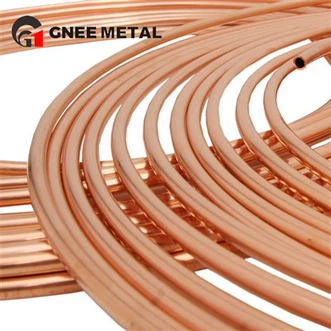


C10100, C10200 and C11000 Copper Tubes
C10100, C10200 and C11000 are three commonly specified copper grades used in electrical, industrial and heat-transfer applications.
Their main differences relate to oxygen content and material requirements.
C10100: Oxygen-Free Electronic Copper with very low oxygen content and high purity.
C10200: Oxygen-Free Copper with controlled low oxygen content.
C11000: Electrolytic Tough Pitch (ETP) copper, known for its high electrical and thermal conductivity.
Although these grades share many copper properties, they are not interchangeable in every application.
| Copper Grade | Material Classification | Oxygen Content | Main Characteristics | Typical Applications |
|---|---|---|---|---|
| C10100 | Oxygen-Free Electronic Copper | Very low | High purity, excellent conductivity | Electronic and specialized industrial components |
| C10200 | Oxygen-Free Copper | Low | High purity, controlled oxygen | Industrial tubing and electrical applications |
| C11000 | Electrolytic Tough Pitch Copper | Controlled oxygen content | High electrical and thermal conductivity | Electrical equipment and heat-transfer components |
Copper Grades for Precision Copper Tubing

C10100 Copper Tubes: Oxygen-Free Electronic Copper
C10100 is an oxygen-free electronic copper grade with high purity and tightly controlled oxygen content.
It is often selected for applications where material purity, electrical conductivity and resistance to hydrogen-related embrittlement are important considerations.
Key Characteristics of C10100
High copper purity.
Very low oxygen content.
Excellent electrical conductivity.
Good thermal conductivity.
Good formability and cold-working characteristics.
Suitable for specialized precision copper components.
Typical Applications
C10100 copper is used in applications such as:
Electronic and electrical components.
Vacuum equipment components.
Specialized industrial tubing.
High-purity copper components.
Applications requiring oxygen-free copper.
For precision copper tubing, C10100 can be considered when the application requires controlled material purity and specific electrical or thermal properties.
However, the final suitability also depends on tube dimensions, temper, manufacturing process and operating environment.
Request a C10100 Copper Tube Quotation
C10200 Copper Tubes: Oxygen-Free Copper
C10200 is another widely recognized oxygen-free copper grade.
Compared with C10100, the primary distinction is the specified chemical composition and oxygen content requirements. Both grades offer high copper purity and good electrical and thermal conductivity.
Key Characteristics of C10200
Oxygen-free copper without residual deoxidants.
High copper purity.
Good electrical conductivity.
Good thermal conductivity.
Good cold-working properties.
Suitable for various industrial and electrical applications.
Typical Applications
C10200 copper is commonly considered for:
Industrial copper tubing.
Electrical components.
Heat-transfer equipment.
Vacuum-related equipment.
Specialized copper parts requiring oxygen-free material.
When Should Buyers Choose C10200?
C10200 may be a suitable choice when oxygen-free copper is required and its specified chemical composition meets the application requirements.
However, buyers should not assume that C10200 is automatically a lower-cost substitute for C10100. The final decision should be based on the required chemical composition, applicable standard, manufacturing condition and performance requirements.
C11000 Copper Tubes: Electrolytic Tough Pitch Copper
C11000 is known as Electrolytic Tough Pitch (ETP) copper. It is one of the most widely used high-conductivity copper grades in electrical and industrial applications.
Unlike C10100 and C10200, C11000 contains a controlled amount of oxygen as part of its material characteristics.
Key Characteristics of C11000
High electrical conductivity.
Excellent thermal conductivity.
Good ductility.
Good cold-forming characteristics.
Widely available in industrial copper products.
Suitable for many electrical and heat-transfer applications.
Typical Applications
C11000 copper is commonly used in:
Electrical conductors and busbars.
Electrical equipment.
Heat-transfer components.
Industrial copper products.
General-purpose copper components.
When Should Buyers Choose C11000?
C11000 is a practical option for applications where high electrical or thermal conductivity is important and oxygen-free copper is not specifically required.
However, its oxygen-bearing nature means it should not automatically replace C10100 or C10200 in applications requiring oxygen-free material.
For applications involving hydrogen-containing atmospheres at elevated temperatures, the risk of hydrogen embrittlement should be considered when selecting ETP copper.
Industrial Copper Tubes for Electrical and Heat-Transfer Applications

C10100 vs. C10200 vs. C11000: Key Differences
| Comparison Item | C10100 | C10200 | C11000 |
|---|---|---|---|
| Material Type | Oxygen-Free Electronic Copper | Oxygen-Free Copper | Electrolytic Tough Pitch Copper |
| Oxygen Content | Very low | Very low | Contains controlled oxygen |
| Copper Purity | High | High | High |
| Electrical Conductivity | Excellent | Excellent | Excellent |
| Thermal Conductivity | Excellent | Excellent | Excellent |
| Hydrogen Embrittlement Considerations | High resistance | High resistance | Requires consideration |
| Typical Applications | Electronic and specialized components | Industrial and electrical applications | Electrical and heat-transfer components |
Which Grade Is More Suitable?
The choice depends on the performance requirements of the finished tube.
Choose C10100 when high-purity oxygen-free copper and strict oxygen control are required.
Choose C10200 when oxygen-free copper is required and its material specifications meet the application requirements.
Choose C11000 when high conductivity is important and oxygen-free material is not a specific requirement.
It is also important to compare the specified temper, mechanical properties and manufacturing requirements rather than selecting a material based on conductivity alone.
Email Our Copper Materials Team
Copper Tube Dimensions and Specifications Buyers Should Confirm
Essential Copper Tube Specifications
| Specification | Description | Example |
|---|---|---|
| Copper Grade | Material designation | C10100 |
| Outside Diameter (OD) | External tube diameter | 0.125 in |
| Inside Diameter (ID) | Internal tube diameter | 0.061 in |
| Wall Thickness (WT) | Thickness of tube wall | 0.032 in |
| Length | Required length per piece | 10 ft |
| Manufacturing Type | Tube construction | Seamless |
| Temper | Material condition | Annealed / Drawn |
| Surface Finish | Required surface condition | Mill Finish |
| Standard | Applicable product specification | ASTM B75/B75M |
| Quantity | Purchasing volume | 40,000 lbs |
How to Calculate Copper Tube Wall Thickness
For round copper tubes, wall thickness can be calculated using the outside diameter and inside diameter.
WT = (OD - ID) / 2
Where:
WT = Wall Thickness
OD = Outside Diameter
ID = Inside Diameter
For example, if a copper tube has an outside diameter of 0.225 inches and an inside diameter of 0.185 inches:
WT = (0.225 - 0.185) / 2 = 0.020 in
The calculated wall thickness is 0.020 inches.
This calculation is useful when reviewing drawings, preparing RFQs and checking whether a proposed tube specification is consistent.
Why Dimensional Tolerances Matter
Two copper tubes may have the same nominal outside diameter but different dimensional tolerances.
For precision applications, buyers should confirm:
OD tolerance.
ID tolerance.
Wall thickness tolerance.
Length tolerance.
Straightness requirements.
If the application involves tight assembly clearances, fluid flow or precision connections, these tolerances should be clearly stated in the purchase specification.
Do not assume that a standard dimensional tolerance will meet every application. Special tolerance requirements should be agreed upon before production.
ASTM Standards and Material Certifications for Copper Tubes
Common ASTM Standards to Understand
| ASTM Standard | Product / Material Scope | Purchasing Consideration |
|---|---|---|
| ASTM B75/B75M | Seamless copper tubes | Covers C10100 and C10200 among its specified grades |
| ASTM B68 | Seamless copper tube, bright annealed | Relevant when the specified product and temper requirements match |
| ASTM B170 | Oxygen-free copper refinery shapes | Relevant to oxygen-free copper material requirements, not a general finished-tube specification |
| ASTM B111/B111M | Seamless copper and copper-alloy condenser tubes and ferrule stock | Relevant to specified condenser, evaporator and heat-exchanger applications |
Important: ASTM B75/B75M covers seamless copper tubes and includes C10100 and C10200 among its specified grades. C11000 is not listed in its standard grade scope. Buyers requesting C11000 tubing should confirm the appropriate product specification with the manufacturer instead of automatically applying B75.
Common Inspection Methods
Depending on the product specification, inspection may include:
Chemical composition analysis.
Tensile testing.
Hardness testing.
Grain-size examination.
Dimensional inspection.
Eddy-current testing or other applicable nondestructive testing.
Not every method is required for every copper tube order. The applicable standard and agreed inspection plan determine which tests are necessary.
Chemical Composition Testing and Quality Inspection of Copper Tubes

Request Copper Tube MTC and Inspection Information
Common Mistakes When Selecting Copper Grades for Precision Tubing
Treating C10100 and C10200 as Identical Materials
Both are oxygen-free copper grades, but their chemical composition requirements are not identical.
Buyers should specify the exact UNS designation rather than simply requesting oxygen-free copper.
Choosing C11000 When Oxygen-Free Copper Is Required
C11000 offers excellent conductivity, but it is not an oxygen-free copper grade.
If the application requires oxygen-free material, C10100 or C10200 should be evaluated instead.
Specifying Only the Outside Diameter
The outside diameter alone does not fully define a copper tube.
Buyers should also specify the inside diameter or wall thickness, dimensional tolerances and tube length.
Ignoring Temper Requirements
The same copper grade can be supplied in different temper conditions.
An annealed tube and a hard-drawn tube may have significantly different mechanical properties and forming capabilities.
Not Confirming the Applicable ASTM Standard
A material designation does not automatically define every requirement for a finished copper tube.
Buyers should confirm the product standard, material grade, temper, dimensions and inspection requirements together.
Custom Precision Copper Tubing from Manufacturer
Selecting the right copper grade is the foundation of a successful precision copper tube order. Equally important are manufacturing capability, dimensional control and material traceability.
As a copper materials supplier, we provide copper products in different grades, dimensions and specifications for industrial and commercial applications.
Our Copper Tube Supply Capabilities
We supply copper tubes in different grades, manufacturing conditions, dimensions and lengths for industrial, electrical, heat transfer and precision applications.
|
Supply Item |
Available Range |
|---|---|
|
Copper Grades |
C10100, C10200, C11000, C12000, C12200, C14200, C14500 and other copper grades upon request |
|
Manufacturing Type |
Seamless copper tubes; welded copper tubes subject to grade, dimensions and application requirements |
|
Product Shapes |
Round tubes, square tubes and rectangular tubes |
|
Outside Diameter (OD) |
3 mm–300 mm |
|
Wall Thickness |
0.5 mm–30 mm |
|
Inside Diameter (ID) |
Available according to OD and wall thickness requirements |
|
Tube Length |
1 m–12 m; custom lengths available |
|
Temper |
O60 (Annealed), H55 (Light Drawn), H58 (Drawn) and other tempers subject to grade and specification |
|
Surface Condition |
Mill finish, bright annealed, polished and other specified surface conditions |
|
Applicable Standards |
ASTM, ASME, EN, JIS and other standards, depending on copper grade and product form |
|
Inspection & Documents |
Mill Test Certificate (MTC), chemical composition report, dimensional inspection report and other agreed documents |
|
Packaging |
Bundles, protective wrapping, wooden cases and export packaging according to tube dimensions and shipping requirements |
What Information Should You Provide for a Quotation?
To help us evaluate your requirements and prepare an accurate quotation, please provide:
Copper grade and applicable ASTM specification.
Outside diameter and inside diameter or wall thickness.
Required tube length.
Seamless or welded construction.
Temper and surface finish.
Total purchasing quantity.
Required delivery destination.
Special dimensional tolerances or inspection requirements.
We can review your specifications, evaluate manufacturing feasibility and provide quotations according to your required dimensions and purchasing volume.
Precision Copper Tubes Prepared for Export

Send Us Your Copper Tube Drawings
FAQ
Q: 1. What is the difference between C10100 and C10200 copper?
A: Both are oxygen-free copper grades. C10100 is oxygen-free electronic copper, while C10200 is oxygen-free copper without residual deoxidants. Their chemical composition requirements differ, so the exact grade should be specified when ordering.
Q: 2. Is C11000 suitable for precision copper tubes?
A: Yes, C11000 can be considered for copper tubing applications where its electrical conductivity, thermal conductivity and mechanical properties meet the requirements. However, the manufacturing process and applicable product standard must be confirmed.
Q: 3. Which copper grade is best for small-diameter copper tubing?
A: There is no single best grade for every small-diameter copper tube. C10100, C10200 or C11000 may be suitable depending on the application, dimensional requirements, mechanical properties and manufacturing process.
Q: 4. Can C10100 copper tubes be manufactured with thin walls?
A: Thin-wall C10100 copper tubes can be evaluated for custom manufacturing. Feasibility depends on outside diameter, wall thickness, tube length, tolerances and production capabilities.
Q: 5. What ASTM standard applies to seamless C10100 copper tubes?
A: ASTM B75/B75M covers seamless copper tubes and includes C10100 and C10200. The required temper, dimensions and applicable inspection requirements should also be confirmed.
Q: 6. What documents should buyers request when purchasing copper tubes?
A: Common documents include:
Mill Test Certificate (MTC).
Chemical composition analysis.
Dimensional inspection records.
Applicable mechanical test results.
Packing list and commercial invoice.
The final documentation package depends on the purchase specification and inspection agreement.