


This specification (ASTM B68) establishes the requirements for bright annealed seamless copper tube suitable for use in refrigeration, oil lines, gasoline lines, and similar applications where a tube with an interior surface essentially free from scale and dirt is required. GNEE supplies C12200 tubes manufactured to this specification.
ASTM B68 permits the following Copper UNS Numbers:
| Copper UNS No. | Type of Copper |
|---|---|
| C10200 | Oxygen-free without residual deoxidants |
| C10300 | Oxygen-free, extra low phosphorus |
| C10800 | Oxygen-free, low phosphorus |
| C12000 | Phosphorus deoxidized, low residual phosphorus |
| C12200 | Phosphorus deoxidized, high residual phosphorus (most common) |
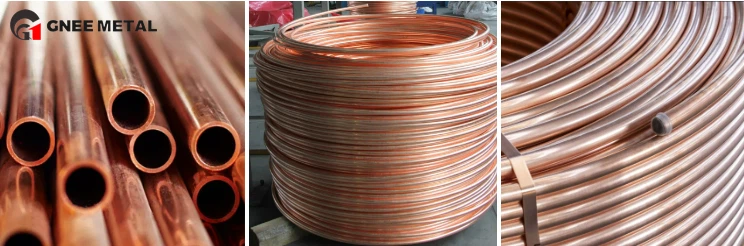
ASTM B68 vs ASTM B111 for C12200
| Feature | ASTM B68 | ASTM B111 |
|---|---|---|
| Title | Seamless Copper Tube, Bright Annealed | Copper & Copper Alloy Seamless Condenser Tubes & Ferrule Stock |
| Primary Application | Refrigeration, oil lines, gasoline lines, clean interior surface | Heat exchangers, condensers, evaporators |
| Surface Condition | Bright annealed (controlled atmosphere) | Not specified – typically mill finish |
| Key Tests | Expansion (40% for OD ≤ 3/4″), flattening, optional eddy-current | Expansion (30%), flattening, hydrostatic test |
| Temper | O50 (light annealed) or O60 (soft annealed) | O61 (annealed) |
| Tensile Strength | Minimum 30 ksi (205 MPa) | 30 – 45 ksi (205 – 310 MPa) |
| Elongation | Minimum 40% (in 2″) | Minimum 35% (in 2″) |
| Yield Strength | Not specified | 10 – 15 ksi (69 – 103 MPa) |
| Grain Size | Specified (see table below) | Not specified |
| Hydrogen Embrittlement Test | Required for C12200 (ASTM B577, Procedure B) | Not mandatory |
| Cuprous Oxide Test | Not required for C12200 | Not required |
GNEE Recommendation: Use ASTM B68 for refrigeration, oil/gas lines, and clean interior surface applications. Use ASTM B111 for heat exchanger and condenser service.
ASTM B68 – Chemical Composition (C12200)
| Element | Copper (Cu) | Phosphorus (P) |
|---|---|---|
| Content (%) | 99.9% min | 0.015 – 0.040% |
ASTM B68 – Temper & Grain Size Requirements
| Temper | Designation | Grain Size Requirement |
|---|---|---|
| O50 | Light annealed | 0.025 – 0.060 mm (average) |
| O60 | Soft annealed | 0.040 mm max (average) |
ASTM B68 – Mechanical Property Requirements
| Property | Requirement for C12200 |
|---|---|
| Tensile Strength (minimum) | 30 ksi (205 MPa) |
| Elongation (minimum, in 2″ gage length) | 40% |
ASTM B68 – Expansion Test Requirements
| Outside Diameter | Expansion Requirement |
|---|---|
| 3/4″ and under | 40% expansion – no cracks or ruptures |
| Over 3/4″ | 30% expansion – no cracks or ruptures |
Test method: ASTM B153 (Pin Test). A flattening test is an optional alternative for annealed tube over 4″ in diameter.
ASTM B68 – Hydrogen Embrittlement & Cuprous Oxide Tests
| Test | Requirement for C12200 |
|---|---|
| Cuprous Oxide Detection (ASTM B577, Procedure A) | Not required for C12200 (only for C10200, C10300, C12000) |
| Hydrogen Embrittlement Test (ASTM B577, Procedure B) | Required (if specified in ordering information). C12200 shall pass. |
ASTM B68 – Nondestructive Testing (Eddy-Current)
Drilled Hole Standards for Eddy-Current Test:
| Tube Outside Diameter (in.) | Diameter of Drilled Hole (in.) | Drill Number |
|---|---|---|
| 1/4 to 3/4, incl | 0.025 | 72 |
| Over 3/4 to 1, incl | 0.031 | 68 |
| Over 1 to 1-1/4, incl | 0.036 | 64 |
| Over 1-1/4 to 1-1/2, incl | 0.042 | 58 |
| Over 1-1/2 to 1-3/4, incl | 0.046 | 56 |
| Over 1-3/4 to 2, incl | 0.052 | 55 |
ASTM B68 – Dimensions & Tolerances
Dimensions and tolerances follow ASTM B251 (General Requirements for Wrought Seamless Copper and Copper-Alloy Tube). GNEE can supply:
| Parameter | Typical Range |
|---|---|
| Outside Diameter | 1/8″ – 3-1/8″ (3.2mm – 79.4mm) |
| Wall Thickness | 0.005″ – 0.250″ (0.13mm – 6.35mm) |
| Length | Straight lengths or coils |
| Surface | Bright annealed – clean, free of scale and dirt |
Workmanship, Finish, and Appearance
Tube shall be clean, free of dirt, scale, and other defects
Bright annealed after the last drawing operation (or after coiling if required)
Interior and exterior surfaces shall be typical of bright annealed copper
Blemishes that do not interfere with intended application are acceptable
Sampling & Lot Size (ASTM B68)
| Lot Size | Number of Sample Portions |
|---|---|
| 1 – 50 pieces | 1 |
| 51 – 200 pieces | 2 |
| 201 – 1500 pieces | 3 |
| Over 1500 pieces | 0.2% of total (max 10 pieces) |
ASTM B111 – Additional Requirements for Heat Exchanger Tubes
For customers who require C12200 tubes for heat exchanger or condenser service, GNEE also supplies to ASTM B111 with the following additional requirements:
| Parameter | ASTM B111 Requirement for C12200 |
|---|---|
| Yield Strength (0.5% ext.) | 10 – 15 ksi (69 – 103 MPa) |
| Hydrostatic Test | Leak-free at specified pressure |
| Temper | O61 (annealed) – similar to O60 |
| Expansion | 30% (not 40%) |
FAQ
1. What is the main difference between ASTM B68 and ASTM B111 for C12200 tube?
ASTM B68 C12200 is for bright annealed seamless tube used in refrigeration, oil lines, and gasoline lines – requiring a clean, scale-free interior surface and 40% elongation. ASTM B111 C12200 is for seamless heat exchanger and condenser tubes – requiring hydrostatic testing and specified yield strength (10-15 ksi) . Choose based on your application.
2. Can C12200 ASTM B68 tube be used for heat exchanger applications?
Yes, but ASTM B111 is the preferred standard for heat exchangers. C12200 meets both standards chemically, but ASTM B111 requires additional tests (yield strength, hydrostatic) that ASTM B68 does not. For heat exchanger service, GNEE recommends ASTM B111 certified tubes.
3. What is the minimum elongation requirement for C12200 under ASTM B68?
ASTM B68 requires a minimum elongation of 40% (in 2″ gage length) for C12200 tube. This is higher than ASTM B111 (which requires 35%), reflecting the more ductile, bright annealed condition.
4. What is the difference between O50 and O60 temper in ASTM B68?
O50 (light annealed) has a grain size of 0.025-0.060 mm – slightly harder, more dimensional stability. O60 (soft annealed) has a grain size of 0.040 mm maximum – softer, more ductile. Both meet the 30 ksi tensile and 40% elongation requirements.
5. Does ASTM B68 require a hydrogen embrittlement test for C12200?
Yes, if specified in the ordering information. ASTM B68 requires C12200 to pass the hydrogen embrittlement test per ASTM B577, Procedure B. This ensures the phosphorus deoxidation is effective and the tube will not crack during welding or brazing.
6. What is the expansion test requirement for C12200 under ASTM B68?
For OD ≤ 3/4″ : 40% expansion without cracks. For OD > 3/4″ : 30% expansion without cracks. This is more demanding than ASTM B111 (which requires 30% for all sizes), reflecting the higher ductility of bright annealed tube.
7. What is the difference between C12200 and C12000 for ASTM B68 tubes?
C12200 has 0.015-0.040% phosphorus (high residual phosphorus). C12000 has 0.004-0.015% phosphorus (low residual phosphorus). C12200 offers better weldability and brazeability due to higher phosphorus content. Both are permitted under ASTM B68.
8. Is eddy-current testing mandatory for ASTM B68 C12200 tubes?
No, it is optional – only required when specified in the purchase order. If specified, tubes up to 3-1/8″ OD shall be tested per ASTM E243 using drilled hole or notch standards. GNEE can provide eddy-current testing upon request.
9. What is the equivalent European standard for ASTM B68 C12200?
EN 12449 (Copper and copper alloys – Seamless round tubes for general purposes) is the closest European equivalent. For bright annealed condition, EN 12449 with surface condition specified is used. GNEE can supply to either standard.
10. Can C12200 ASTM B68 tube be welded or brazed?
Yes, C12200 is specifically designed for welding and brazing. The phosphorus deoxidation prevents hydrogen embrittlement. ASTM B68 requires passing the hydrogen embrittlement test (ASTM B577, Procedure B) to confirm this capability.
11. How can I get a certified mill test report for C12200 to ASTM B68 or ASTM B111 from GNEE?
GNEE provides traceable mill test reports (MTR) for C12200 tubing supplied to ASTM B68 or ASTM B111. The MTR includes: chemical analysis, tensile strength, elongation, grain size (for B68), expansion test results, flattening test results (if specified), hydrogen embrittlement test results (if specified), and heat number. Contact GNEE sales with your standard (ASTM B68 or B111), size, temper, and quantity requirements.
Our copper product packaging
Our copper products are carefully packed using strong wooden cases, moisture-proof paper, plastic caps for tube/pipe ends, and steel strapping to ensure protection during long-distance sea or air freight.
Each layer is separated with foam or plastic spacers to prevent scratching and deformation, while standard export seaworthy packaging meets ISPM-15 requirements. Clear product labels (grade, size, quantity, heat number) are attached to each bundle or coil, and additional anti-tarnish paper is added for high-humidity destinations to guarantee that the copper tubes, sheets, rods, wires, and strips arrive in perfect condition at your warehouse.

Our factory

Our factory
Our factory is equipped with integrated production lines for copper tubes, sheets, rods, wires, and strips, featuring advanced extrusion, rolling, drawing, and annealing machinery. We utilize precision equipment such as continuous casting and rolling lines, high-speed wire drawing machines, and hydraulic presses to ensure consistent dimensions and surface quality. For quality control, we have an in-house testing center equipped with spectrometers, tensile testers, hardness testers, eddy current flaw detectors, and metallographic microscopes, enabling us to monitor material composition, mechanical properties, and surface defects at every stage of production.


