


These tubes are composed of 99.9% copper, offering high thermal conductivity and resistance to corrosion.
Phosphorus-deoxidized copper tubes (C12200) are made from 99.9% pure copper, deoxidized with phosphorus to enhance thermal conductivity and resistance to corrosion. This makes them ideal for heat exchanger applications, particularly where water or steam is involved.
Known for their durability and weldability, these tubes are a top choice in sugar refineries, where they are extensively utilized in condensers and evaporators, and the refrigeration industry, where they play a pivotal role in efficient heat transfer in cooling systems. (GNEE supplies these tubes for such applications.)
These tubes are essential for effectively transferring heat from steam to water or air, making them a preferred choice in industries requiring reliable and durable heat transfer solutions.


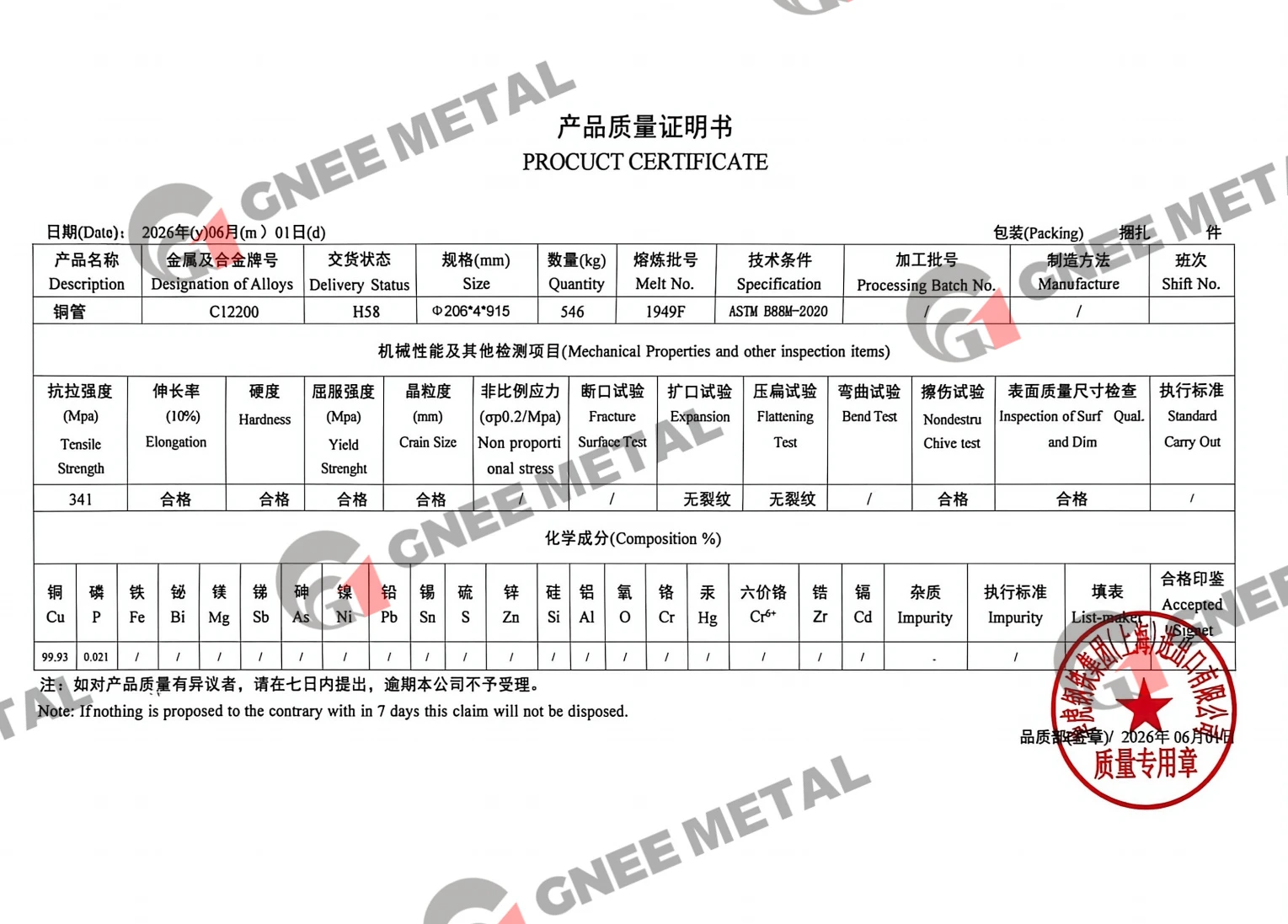
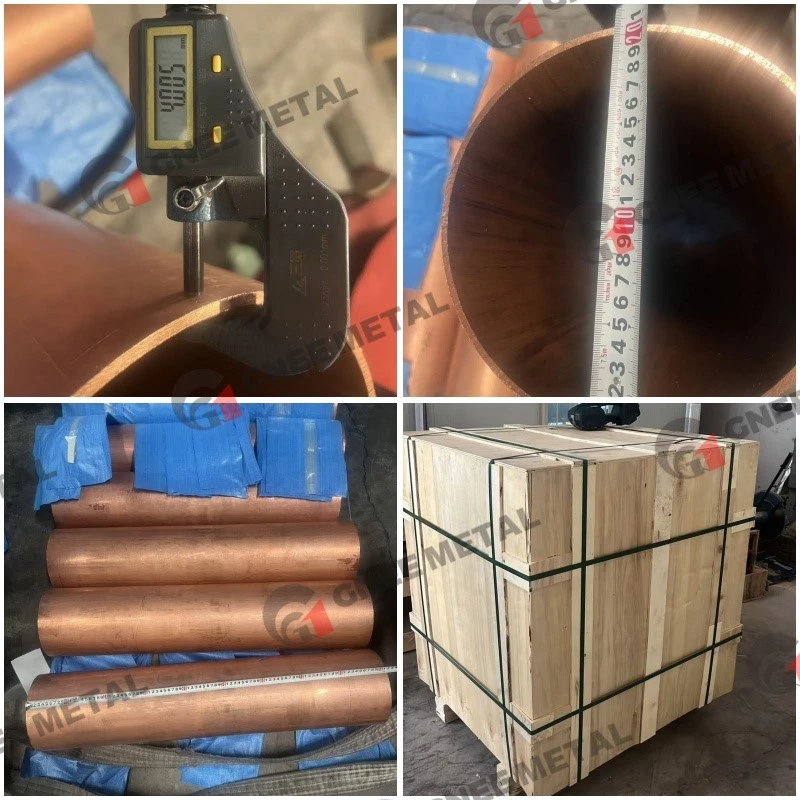
Export Case : Canada – ASTM B88 Large Diameter Custom Copper Tube
We recently completed an export order of C12200 copper tube to Canada. The product was strictly manufactured according to ASTM B88 standard and is a large diameter, non-standard custom tube, used in the main water supply system of a local commercial building.
Applications
C12200 copper tubes are commonly used in:
Industrial heat exchangers, condensers, and evaporators
HVAC systems and refrigeration units
Water heaters and solar thermal panels
Steam-to-water and steam-to-air heat transfer systems
General piping and fluid distribution in corrosion-sensitive installations
Key Benefits
| Benefit | Description |
|---|---|
| Excellent thermal conductivity | Enables fast and efficient heat exchange with minimal energy loss. |
| High corrosion resistance | Suitable for use in freshwater and mildly aggressive environments. |
| Ease of fabrication and joining | Supports brazing, welding, and soldering for efficient assembly. |
| Proven reliability | Performs under high-pressure and high-temperature conditions. |
| Long service life | Maintains structural and thermal performance over years of use. |
| Standards compliance | Meets ASTM B75, B111, B395 and ASME SB111, SB395 specifications. |
Technical Specifications
| Parameter | Details |
|---|---|
| UNS No. | C12200 – BSI No. C107 – ISO name Cu-DHP |
| Chemical Composition | Cu 99.9% / P 0.015% ~ 0.040% |
| ASTM Specification | B 75, B 111, B 395 |
| ASME Specification | SB 111, SB 395 |
| Common Applications | Industrial heat exchangers, condensers, evaporators; HVAC systems, water heaters, solar panels |
| Temper | H55 (light drawn) / H80 (hard drawn) / O61 (annealed) |
Properties & Metrics
| Property | Metric | English |
|---|---|---|
| Density | 8.94 g/cm³ | 0.323 lb/in³ |
| Tensile Strength | 221 ~ 379 MPa | 32 ~ 55 ksi |
| Yield Strength | 69 ~ 345 MPa | 10 ~ 50 ksi |
| CTE, linear | 17.7 × 10⁻⁶/°C @ 20–300°C | 9.8 × 10⁻⁶/°F @ 70–570°F |
| Specific Heat Capacity | 0.0920 cal/g-°C @ 20°C | 0.0920 BTU/lb-°F @ 70°F |
| Thermal Conductivity | 339 W/m-K @ 20°C | 196 BTU/ft²/ft/h/°F @ 70°F |
| Melting Point | 1083°C | 1981°F |
C12200 vs C11000 Copper
| Property | C12200 Copper | C11000 Copper |
|---|---|---|
| UNS Designation | C12200 | C11000 |
| Common Name | Phosphorus-Deoxidized Copper (DHP) | Electrolytic Tough Pitch Copper (ETP) |
| Copper Content | ≥ 99.9% Cu | ≥ 99.90% Cu |
| Oxygen | Very low / deoxidized | Typically 0.02–0.04% |
| Phosphorus | Approx. 0.015–0.040% | Very low |
| Electrical Conductivity | Lower than C11000 | Higher |
| Thermal Conductivity | Good | Excellent |
| Weldability | Excellent | Good, but hydrogen embrittlement can be a concern |
| Brazing | Excellent | Good |
| Formability | Excellent | Excellent |
| Corrosion Resistance | Excellent | Excellent |
| Pressure Piping | Excellent | Generally not the first choice |
| Heat Exchanger Tubes | Excellent | Good |
| HVAC / Refrigeration | Excellent | Common |
| Electrical Applications | Good | Excellent |
| Typical Products | Tubes, pipes, coils, fittings | Busbars, wires, sheets, plates, bars, tubes |
| Typical Applications | HVAC, refrigeration, plumbing, heat exchangers | Electrical conductors, busbars, electrical components, heat transfer |
| Main Advantage | Excellent weldability and suitability for tubing | High electrical and thermal conductivity |
How to Choose
Choose C12200 when you need copper tubing, pressure piping, refrigeration lines, heat exchanger tubes, or excellent welding/brazing performance.
Choose C11000 when maximum electrical or thermal conductivity is the priority, especially for busbars, electrical conductors, and electrical components.
FAQ
1. What is the difference between C12200 and C11000 copper?
C12200 (DHP copper) contains a small amount of phosphorus (0.015-0.040%) for deoxidation, which makes it suitable for welding and brazing. C11000 (ETP copper) has higher electrical conductivity but is not recommended for welding because its oxygen content can cause embrittlement when exposed to hydrogen.
2. What are the equivalent specifications for C12200 copper tube?
C12200 is equivalent to BSI No. C107 (British Standard), ISO name Cu-DHP, and DIN 2.0090. It also meets ASTM B75, B111, B395 and ASME SB111, SB395 specifications.
3. Can C12200 copper tube be welded?
Yes, C12200 is specifically designed for welding. The phosphorus deoxidation removes oxygen from the copper, preventing hydrogen embrittlement. It can be welded using TIG (GTAW) and MIG (GMAW) processes, and also supports brazing and soldering.
4. What is the thermal conductivity of C12200 copper tube?
C12200 has a thermal conductivity of 339 W/m-K at 20°C (196 BTU/ft²/ft/h/°F at 70°F). While slightly lower than pure copper (C11000 at ~391 W/m-K), it still provides excellent heat transfer for heat exchangers and HVAC applications.
5. What temper options are available for C12200 copper tube?
C12200 is available in three tempers: O61 (annealed/soft) – for bending and flaring; H55 (light drawn) – moderate strength; H80 (hard drawn) – maximum strength for straight tube applications.
6. Is C12200 suitable for marine or saltwater applications?
C12200 has good corrosion resistance in freshwater, but for saltwater or marine environments, it is recommended to use C70600 (90/10 copper-nickel) or C71500 (70/30 copper-nickel), which offer superior resistance to seawater corrosion and biofouling.
7. What industries commonly use C12200 DHP copper tubes?
C12200 tubes are widely used in: sugar refineries (condensers and evaporators), HVAC and refrigeration (cooling systems), power generation (steam-to-water heat exchangers), solar thermal systems, and water heaters.
8. What is the yield strength of C12200 copper tube in annealed condition?
In the annealed (O61) temper, C12200 has a yield strength of approximately 69 MPa (10 ksi). In hard drawn (H80) temper, the yield strength can reach up to 345 MPa (50 ksi).
9. Can C12200 copper tube be used for high-temperature applications?
Yes, C12200 performs well at elevated temperatures. Its melting point is 1083°C (1981°F). For continuous service, it can operate up to ~300°C without significant loss of mechanical properties. For higher temperatures, other alloys may be considered.
10. How does C12200 compare to C12200T? Is there a difference?
C12200 and C12200T are the same material. The "T" sometimes indicates "tube" form in some supplier catalogs. Both refer to the same UNS designation for phosphorus-deoxidized copper with the same chemical and mechanical requirements.
11. What is the standard manufacturing process for C12200 seamless tube?
C12200 seamless tube is typically manufactured by extrusion or piercing a cast billet, followed by cold drawing to achieve precise dimensions. It is then annealed to achieve the desired temper (O61, H55, or H80) and tested to ASTM/ASME standards.
Product Range – Copper Products
| Category | Common Shapes / Types | Typical Applications |
|---|---|---|
| Copper Tube | Straight pipe, Coiled tube, Capillary tube, Inner grooved tube | Air conditioning, refrigeration, heat exchangers, plumbing |
| Copper Sheet / Plate | Flat sheet, coiled strip (thick plate: >6mm, thin sheet: 0.2–6mm) | Roofing, industrial panels, transformers, gaskets |
| Copper Rod / Bar | Round bar, hexagonal bar, square bar, busbar | Electrical components, machining parts, grounding bars |
| Copper Wire | Round wire, flat wire, tinned wire, bare copper wire | Cables, winding wires, jewelry, mesh, electrical conductors |
Optional – Detailed Specification Columns
| Product | Material Grade | Diameter / Thickness | Width | Length / Coil ID | Standard |
|---|---|---|---|---|---|
| Copper Tube | C12200, C11000 | 3–100 mm (OD) | – | 3–6 m / coil | ASTM B280, EN 1057 |
| Copper Sheet | C11000, C10200 | 0.3–20 mm | 200–1000 mm | 1000–3000 mm | GB/T 2040, ASTM B152 |
| Copper Rod | C11000, C18200 | 3–80 mm (dia.) | – | 2–4 m | ASTM B187, EN 12163 |
| Copper Wire | C11000, C10100 | 0.1–6 mm (dia.) | – | coil (50–200 kg) | ASTM B3, IEC 60228 |
Our factory
Our factory is equipped with integrated production lines for copper tubes, sheets, rods, wires, and strips, featuring advanced extrusion, rolling, drawing, and annealing machinery. We utilize precision equipment such as continuous casting and rolling lines, high-speed wire drawing machines, and hydraulic presses to ensure consistent dimensions and surface quality. For quality control, we have an in-house testing center equipped with spectrometers, tensile testers, hardness testers, eddy current flaw detectors, and metallographic microscopes, enabling us to monitor material composition, mechanical properties, and surface defects at every stage of production.


