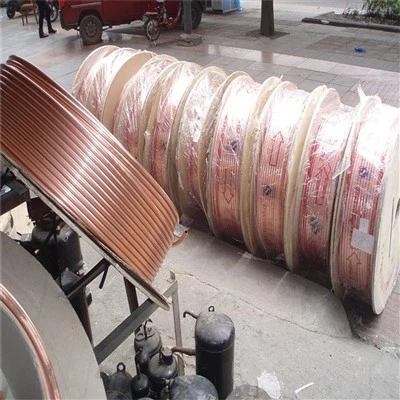
What Are Extruded Brass Bars?
Extruded brass bars are produced by forcing a heated solid brass billet through a shaped die under high pressure. The die determines the cross-sectional shape of the bar, such as round, square, or hexagonal.
The extrusion process changes the billet into a continuous bar. Depending on the required product specification, the bar may undergo further operations such as straightening, cutting, drawing, or surface finishing.
Hot Extrusion – Brass Billet Through the Extrusion Press
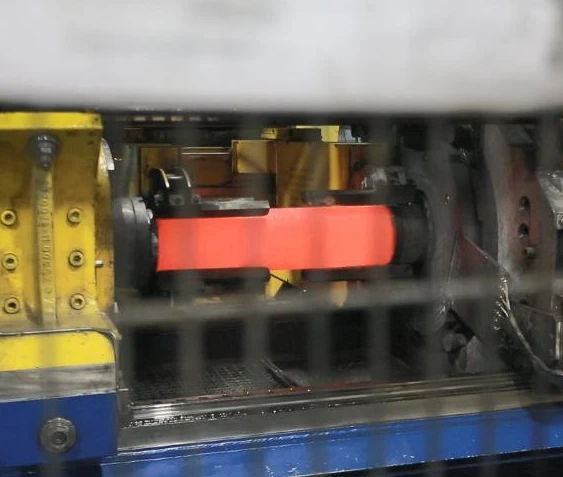
How the Extrusion Process Works
Billet preparation: A brass billet with a suitable chemical composition and size is prepared.
Heating: The billet is heated to the required extrusion temperature.
Extrusion: A hydraulic press pushes the billet through a die to form the required cross-section.
Cooling and straightening: The extruded bar is cooled and straightened as required.
Cutting and finishing: The bar is cut to length and may receive additional surface or dimensional processing.
Inspection: Diameter, straightness, surface condition, and material requirements are checked.
The main advantage of extrusion is that it can produce solid brass bars in different cross-sectional shapes and relatively large diameters. However, the dimensional tolerance of an extruded bar is generally not as tight as that of a precision-drawn bar without further processing.
Typical Applications
Extruded brass bars are used for:
CNC-machined brass components
Industrial fittings and connectors
Valve and plumbing components
Electrical and mechanical parts
Components requiring further machining or finishing
For C3604 brass, extrusion is one available production route for round bars. The final suitability depends on the bar diameter, tolerance, surface condition, and machining requirements.
What Are Continuous Cast Brass Bars?
Continuous cast brass bars are produced by pouring molten brass into a water-cooled mold or crystallizer. The metal solidifies as it passes through the casting system, and the solidified bar is continuously withdrawn.
The resulting bar is then cut into lengths. Depending on the required application and product specification, further operations may include peeling, turning, drawing, or other surface and dimensional finishing.
Horizontal Continuous Casting Line for Brass Rods
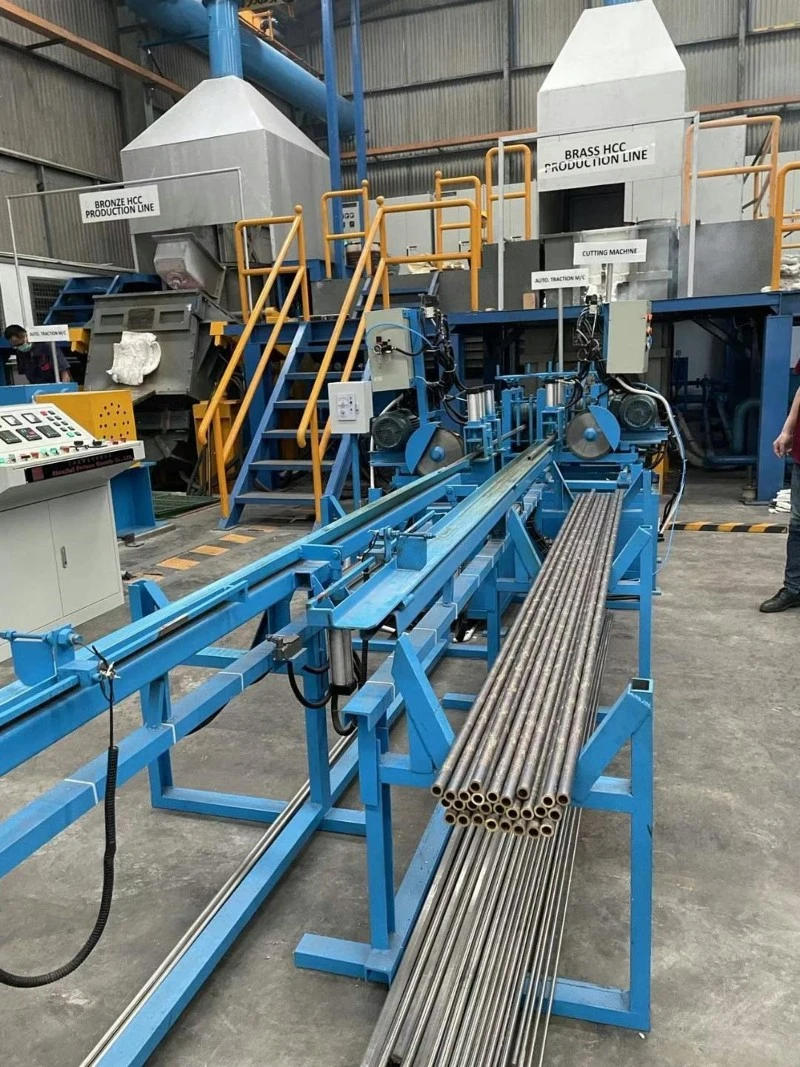
How the Continuous Casting Process Works
Melting: Brass raw materials are melted in a furnace.
Chemical composition control: The molten metal is adjusted and checked to meet the required alloy grade.
Casting: Molten brass flows into a water-cooled mold.
Solidification: The metal solidifies as it moves through the casting system.
Withdrawal and cutting: The continuous bar is withdrawn and cut into manageable lengths.
Further processing and inspection: Additional machining or finishing is carried out when required by the product specification.
The main advantage of continuous casting is its ability to produce long, solid brass stock through a continuous solidification process. It is particularly useful where the required bar dimensions and machining allowance are compatible with the casting route.
Typical Applications
Continuous cast brass bars may be used for:
Machined brass components
Bushings and sleeves
Industrial bearing-related parts
General engineering components
Brass stock for further machining
The appropriate grade and casting quality should be selected according to the component's mechanical and machining requirements.
Extruded vs. Continuous Cast Brass Bars: Main Differences
| Comparison | Extruded Brass Bars | Continuous Cast Brass Bars |
|---|---|---|
| Starting material | Solid brass billet | Molten brass |
| Forming method | Heated billet forced through a die | Molten metal solidifies in a cooled mold |
| Production process | Pressure forming | Continuous solidification |
| Cross-sectional shapes | Round, square, hexagonal and other die-supported shapes | Mainly solid round or other mold-supported sections |
| Surface condition | Depends on extrusion and subsequent finishing | Depends on casting and subsequent finishing |
| Dimensional tolerance | Defined by the applicable product standard and finishing condition | Depends on casting equipment and subsequent finishing |
| Internal quality | Depends on billet quality and extrusion control | Depends on melt quality, solidification and cooling control |
| Machining suitability | Suitable when grade, dimensions and surface condition meet the machining requirement | Suitable when internal quality, machining allowance and final dimensions are appropriate |
| Key purchasing concern | Diameter tolerance, straightness and surface condition | Internal soundness, casting quality and machining allowance |
Neither process automatically produces a better brass bar for every application. Extrusion is a practical option for bars formed from solid billets, while continuous casting is a practical option for producing solid stock directly from molten metal.
Internal Structure and Material Quality
Internal quality is an important consideration when purchasing brass bars, especially for components that require deep drilling, extensive turning, or a large amount of material removal.
Grain Structure
During extrusion, the billet undergoes plastic deformation as it passes through the die. This changes the material's grain structure and can produce a more directionally worked structure.
During continuous casting, the metal solidifies from the liquid state. Grain formation is influenced by the cooling rate, temperature distribution, and solidification conditions.
The two processes create different metallurgical histories, but neither process guarantees better mechanical properties without considering the alloy grade and final material condition.
Porosity and Internal Defects
Continuous cast bars require particular attention to casting-related defects, including:
Gas porosity
Shrinkage cavities
Non-metallic inclusions
Segregation
Surface cracks
These defects are not present in every continuous cast bar. Their occurrence depends on raw material quality, melt treatment, casting temperature, and cooling control.
Extruded bars also require quality control. Defects in the original billet, surface cracks, inclusions, or unsuitable processing conditions can affect the finished product.
Chemical Composition and Batch Consistency
The manufacturing process does not replace the alloy designation.
For example, C3604 and C3602 have their own chemical composition requirements under JIS H 3250. A bar should be identified by its actual grade and supported by material documentation, regardless of whether it is extruded or continuously cast.
When ordering, specify:
Exact brass grade
Required chemical composition standard
Bar diameter and length
Material condition
Inspection and documentation requirements
Machining Performance: Which Process Is Better for CNC Machining?
For CNC machining, the brass grade, material condition, dimensional consistency, and internal quality usually matter more than the process name alone.
Both extruded and continuous cast brass bars can be machined. Their suitability depends on the quality of the finished stock and the machining operation.
Extruded Brass Bars for CNC Machining
Extruded bars can be used for turning, drilling, milling, and other machining operations when their dimensions and material condition meet the job requirements.
Before using extruded bars for precision CNC production, check:
Actual diameter and diameter tolerance
Straightness over the full bar length
Surface condition and oxidation
Consistency between production batches
Whether additional drawing or peeling is required
For automatic lathes and bar feeders, straightness and diameter consistency are especially important. Excessive variation can affect feeding stability and the amount of material removed during machining.
Continuous Cast Brass Bars for CNC Machining
Continuous cast bars can also be machined into industrial components. They may be suitable for parts with sufficient machining allowance and where the casting quality meets the component's requirements.
Buyers should check:
Internal soundness, especially for deep-hole machining
Whether the bar has been peeled or otherwise finished
Actual diameter variation
Surface defects and casting-related imperfections
Machining allowance required to reach the finished dimension
For components with extensive material removal, internal defects can lead to unexpected machining problems and material waste.
What About C3604 and C3602?
C3604 and C3602 are both free-cutting brass grades commonly used for machined components.
| Requirement | C3604 | C3602 |
|---|---|---|
| General machining | Very suitable | Suitable |
| CNC turning | Common choice | Suitable |
| Automatic lathe work | Common choice | Suitable |
| Cold forming after machining | More limited than C3602 | Better suited |
| Typical selection | Cutting-focused components | Components combining machining and forming |
If your main operation is CNC turning or automatic lathe machining, C3604 is generally the more direct choice. If the component requires additional cold forming, swaging, or similar forming operations, C3602 deserves consideration.
Send Your Brass Bar Specifications
Typical Sizes, Lengths and Dimensional Tolerances
Production Size Ranges
| Product Type | Typical Diameter / Size Range | Typical Length |
|---|---|---|
| Drawn brass round bars | 2–75 mm | 2,000–4,000 mm |
| Extruded brass round bars | 25–95 mm in the referenced supplier range | 2,000–4,000 mm |
| Large-diameter brass bars | Depends on grade and production route | Commonly supplied in stock or cut lengths |
JIS H 3250 Dimensional Tolerances for Extruded Bars
For C3602 and C3604 extruded bars, the JIS H 3250 tolerance table gives the following dimensional tolerances:
| Nominal Diameter | Standard Diameter Tolerance |
|---|---|
| 6–25 mm | ±0.3 mm |
| Over 25–30 mm | ±1.2% |
| Over 30 mm | ±1.0% |
For example:
A 20 mm extruded bar with a ±0.3 mm tolerance may measure from 19.7 to 20.3 mm.
A 40 mm extruded bar with a ±1.0% tolerance may measure from 39.6 to 40.4 mm.
A 60 mm extruded bar with a ±1.0% tolerance may measure from 59.4 to 60.6 mm.
Which Process Should You Choose?
| Your Requirement | Recommended Purchasing Approach |
|---|---|
| General-purpose brass machining stock | Compare extruded and continuous cast bars based on grade, dimensions and price |
| CNC turning with a bar feeder | Prioritize diameter consistency, straightness and surface condition; consider drawn or precision-finished bars |
| Large-diameter brass components | Compare available production routes, internal quality and machining allowance |
| Deep-hole drilling | Require clear internal-quality requirements and suitable inspection |
| Components requiring tight dimensional tolerances | Specify the finished diameter tolerance rather than relying on the process name |
| Machining followed by cold forming | Select the brass grade for forming performance first; C3602 may be more suitable than C3604 |
| High-volume production | Compare material cost per usable component, machining time, scrap rate and batch consistency |
Extruded Bars Are a Practical Choice When:
The required diameter and cross-section are available through extrusion.
Standard extruded-bar tolerances are acceptable.
The component will undergo further machining.
The supplier can provide consistent dimensions and surface quality.
Continuous Cast Bars Are a Practical Choice When:
The required bar size is available through continuous casting.
The material will undergo sufficient machining or finishing.
The internal quality meets the component's requirements.
The overall material cost and machining yield are competitive.
Brass Round Bars
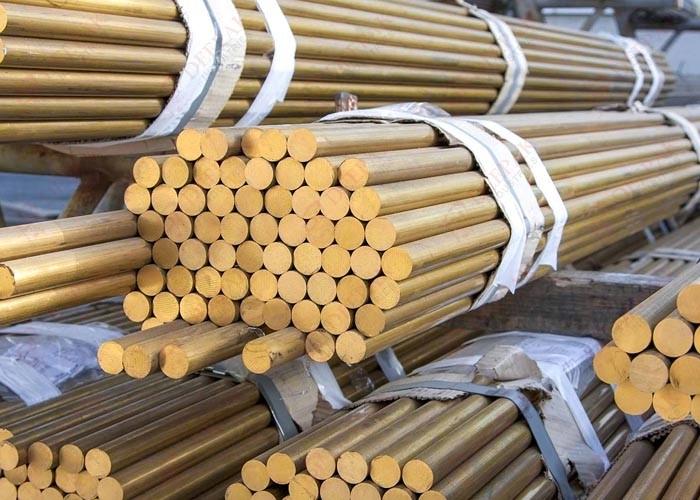
What Should You Check Before Buying Brass Round Bars?
| Item | Information to Provide |
|---|---|
| Material grade | C3604, C3602 or another specified grade |
| Manufacturing process | Extruded or continuous cast, if required |
| Diameter | Exact diameter in mm or inches |
| Length | Full bar length or cut length |
| Diameter tolerance | For example, ±0.10 mm |
| Straightness | Maximum permitted deviation |
| Surface condition | As-produced, drawn, peeled or machined |
| Quantity | Pieces or total weight |
| Inspection | Chemical, mechanical and dimensional checks |
| Documentation | Mill Test Certificate or inspection report |
Lead Time, Cutting and Export Packing
Lead time depends on the required grade, diameter, quantity, finishing process, and whether the material is available in stock.
| Order Type | Indicative Lead Time |
|---|---|
| Available stock, standard cutting | 3–7 working days |
| Regular production order | 15–25 working days |
| Large-diameter or high-volume order | 20–30 working days |
Cutting Length
Common full-bar lengths for brass rods are around 2,000–4,000 mm, depending on the production route and supplier range.
If you require cut pieces, provide the finished length and quantity per size. For example:
500 mm × 200 pcs
1,000 mm × 100 pcs
1,500 mm × 50 pcs
The cutting tolerance should be agreed in the quotation or drawing. Do not assume that a standard full-length tolerance also applies to cut pieces.
Export Packing
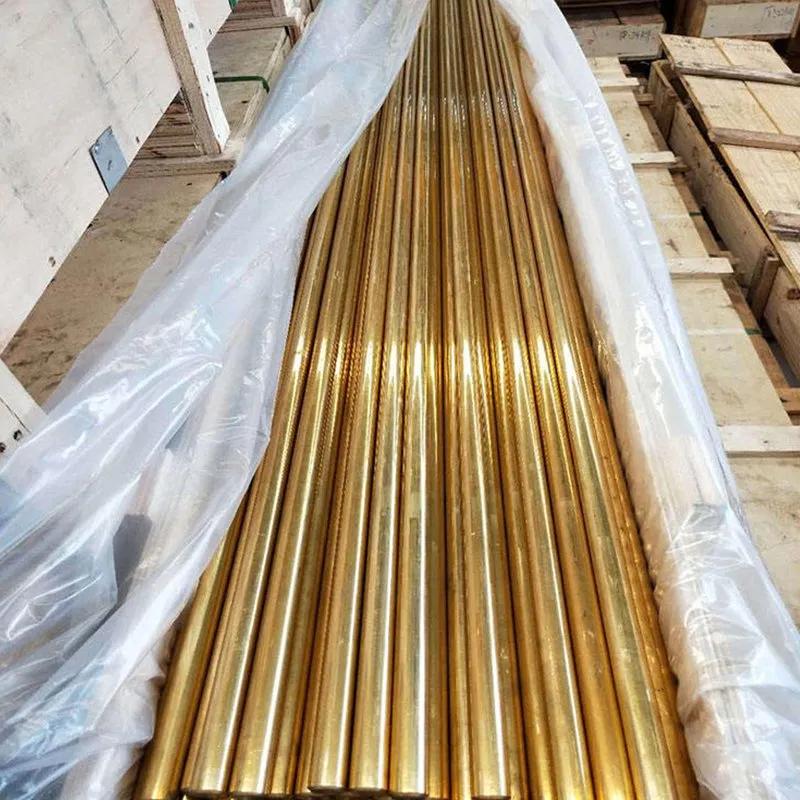
Brass bars should be packed to prevent movement, surface damage, and exposure to moisture during transportation.
Typical export packing includes:
Bundling bars by diameter and length
Protective wrapping to reduce surface scratches
Plastic or waterproof covering where required
Strong wooden crates or reinforced packing for sea freight
Clear labels showing grade, dimensions, quantity and batch identification
Brass Bar Export Packing
FAQ
Q: Are extruded brass bars better than continuous cast brass bars?
A: Not in every application. Extruded bars are formed by pushing a heated billet through a die, while continuous cast bars are formed by solidifying molten brass. The better option depends on the required diameter, tolerance, internal quality, machining process, and final component.
Q: Can continuous cast brass bars be used for CNC machining?
A: Yes. Continuous cast brass bars can be machined when the alloy grade, internal quality, dimensions, and surface condition meet the machining requirements. For deep drilling or heavy material removal, internal quality should receive particular attention.
Q: Are extruded brass bars more accurate than continuous cast bars?
A: There is no universal rule that applies to every supplier. JIS H 3250 specifies tolerances for applicable extruded C3602 and C3604 bars. Continuous cast bar tolerances depend on the casting process and subsequent finishing. For precision machining, compare the actual guaranteed diameter tolerance and straightness.
Q: What is the difference between extruded and drawn brass bars?
A: Extruded bars are formed by forcing a heated billet through a die. Drawn bars undergo an additional drawing operation to reduce or size the cross-section. Drawn bars can achieve tighter dimensional tolerances, making them useful for applications that require more accurate diameters.
Q: Can I order C3604 brass round bars in large diameters?
A: Yes. We can supply large-diameter C3604 brass round bars, including 114.3 mm (4.5 in.) and 115 mm. If you require these sizes, please send us your required length and quantity. We can check the suitable production and delivery arrangements for your order.
Request a Quote for Extruded or Continuous Cast Brass Bars
We supply brass round bars for industrial machining and component manufacturing. To help us check the suitable material and production option, send us the following information:
Brass grade: C3604, C3602 or another grade
Required process: Extruded or continuous cast, if specified
Diameter and length: Exact dimensions
Quantity: Pieces or total weight
Tolerance: Required diameter and length tolerance
Application: CNC turning, drilling, milling, or other machining
If you have a drawing or existing material specification, send it with your inquiry. We can review the dimensions, material grade, and delivery requirements before preparing a quotation.