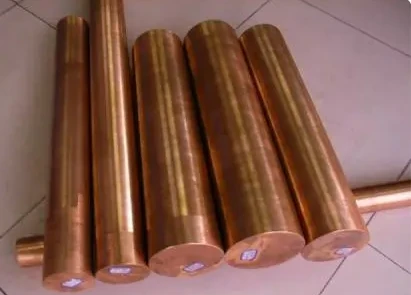
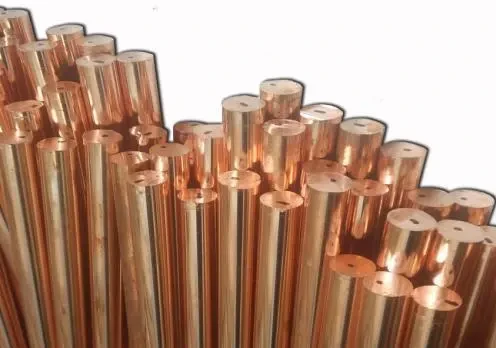
First of all, we need to understand the basic composition of beryllium bronze rods. Beryllium bronze rods are mainly composed of copper, beryllium and other alloying elements, of which the content of beryllium is generally between 0.2% and 2.0%. The preparation process of this alloy requires a fine smelting and casting process to ensure that the elements inside are evenly distributed, so as to achieve the ideal performance.
Beryllium bronze rods have many excellent performance characteristics. First of all, it has extremely high tensile strength and yield strength, which enables it to maintain good stability and reliability under heavy loads and high stress environments. Secondly, beryllium bronze rods also have good electrical and thermal conductivity, which makes it widely used in the electronic and electrical fields. In addition, it also has good corrosion resistance, wear resistance and processing performance, which enables it to meet the needs of various complex and harsh working environments.
In industrial production, beryllium bronze rods have a wide range of applications. First of all, in the electronics industry, it is widely used to manufacture various electronic components and connectors, such as brushes, electrical contacts and motor commutators, etc., providing reliable guarantees for the normal operation of electronic equipment. Secondly, in the automotive industry, beryllium bronze rods are also used to manufacture high-precision, high-strength parts, such as engine valves, drive shafts and bearings, which improve the performance and safety of automobiles. In addition, beryllium bronze rods also play an important role in energy, hardware tools, ships and medical fields.
In addition to its application in various industries, the processing technology of beryllium bronze rods is also an important factor in its wide application. Common processing technologies include casting, forging and cold working. The casting process can cool the liquid metal to form a workpiece or part with a certain shape and size, which is suitable for large-size, thin-walled and complex-shaped parts processing. The forging process changes the shape and size of the material by hammering or pressing, which can improve the mechanical strength and plasticity of the material. Cold working can obtain highly precise dimensions and surface smoothness through methods such as cold rolling and cold drawing. The flexible use of these processing technologies enables beryllium bronze rods to meet various complex and delicate processing needs.
However, beryllium bronze rods also have some limitations and challenges. Due to its complex preparation process and high cost, its price is relatively high, which to a certain extent limits its application in some low-cost fields. In addition, although beryllium bronze rods have excellent performance, their performance may be affected to a certain extent under certain extreme conditions, which requires full consideration and evaluation during the application process.
In general, beryllium bronze rods are a metal material with excellent performance and wide application. With the advancement of science and technology and the development of industry, it is believed that beryllium bronze rods will have broader application prospects in the future. At the same time, we also need to continuously research and explore new preparation processes and processing methods to further improve its performance and reduce costs, and make greater contributions to the development of industrial production and scientific research.