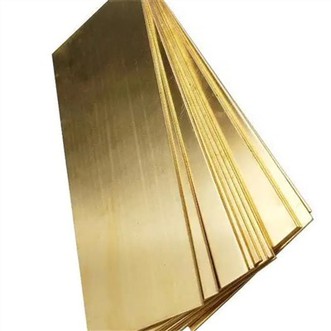
What is H62 brass?
H62 environmentally friendly brass strip is a brass alloy material with copper and zinc as the main components. The copper content is 60.5%~63.5%, with zinc as the balance, iron ≤0.15%, and lead ≤0.08%, conforming to GB/T 2059-2000 standard. This material has good mechanical properties, excellent plasticity in the hot state (650~850℃), and can be deeply drawn in the cold state. It also has good machinability, weldability, and resistance to general corrosion. Its physical states include soft, semi-hard, hard, and O-state.
H62 copper alloy hardness
| Temper Designation (ASTM/GB) | Condition | Hardness (HV) | Hardness (HB) | Hardness (HRB) | Typical Application State |
|---|---|---|---|---|---|
| O (Annealed) | Soft, fully recrystallized | 70 – 100 HV | ~65 – 85 HB | ~55 – 70 HRB | As-supplied for further cold working or hot forming. |
| H02 (¼ Hard) | Lightly cold worked | 95 – 120 HV | ~80 – 100 HB | ~70 – 80 HRB | A good balance of strength and formability. |
| H04 (½ Hard) | Medium cold worked | 110 – 135 HV | ~95 – 115 HB | ~78 – 88 HRB | Common for many structural and mechanical parts. |
| H06 (Hard) | Heavily cold worked | 130 – 160 HV | ~110 – 135 HB | ~85 – 95 HRB | High-strength applications, limited further forming. |
| H08 (Spring Hard) | Extra hard, full hard | ≥ 150 HV | ≥ 130 HB | ≥ 92 HRB | Used for springs, clips, and high-stress components. |
Mechanical Properties of H62 Brass
1. Plasticity: H62 brass exhibits good plasticity in both hot and cold states, allowing it to withstand various complex processing procedures such as deep drawing and bending. Its elongation is approximately 30%, meaning the material can extend to 30% of its original length before fracture, demonstrating its excellent plasticity and toughness.
2. Corrosion Resistance: H62 brass also has good corrosion resistance, but corrosion cracking may occur under certain conditions. Its corrosion resistance is closely related to factors such as material composition, microstructure, and surface treatment. The corrosion resistance of H62 brass can be further improved through reasonable alloy design and heat treatment processes.
3. Tensile Strength and Yield Strength: The tensile strength of H62 brass is typically greater than or equal to 315 MPa, indicating that it can withstand large tensile forces without easily fracturing. Simultaneously, its yield strength is moderate, ensuring that the material does not undergo premature plastic deformation during use.

Inquire about H62 Brass Pricing & Samples
H62 Brass Chemical Composition
|
Element |
Cu |
Zn |
Pb |
Fe |
Total Impurities |
|
Content (%) |
60.5-63.5 |
Remainder (approx. 36.5%-39.5%) |
≤0.08 |
≤0.15 |
≤0.5 |
Physical Properties
|
Property Parameter |
Value |
Remarks |
|
Density |
8.43-8.47 g/cm³ |
Lightweight design advantage |
|
Conductivity |
Approx. 22% IACS |
Meets general conductivity requirements |
|
Thermal Conductivity |
115-120 W/(m·K) |
Suitable for heat dissipation components |
|
Linear Expansion Coefficient |
20.6×10⁻⁶/℃(20-300℃) |
Good thermal stability |
|
Melting Point |
905-930℃ |
Good casting fluidity |
How Does H62 Brass Compare to Other Brass Alloys?
H62 offers a great balance of strength and ductility in your brass. Why would you choose H70 over H62? It's going to be more ductile. It's going to be easier to cold work. On the other hand, if you pick H59, you'll get a stronger brass, but it won't have the ductility that H62 does. H62 brass is in the middle. It gives you a great combination of strength and workability. That's why it's such a good all-around brass for most of us.
FAQ
| Is H62 brass better than 360 brass? H62 Brass: Offers good strength, ductility, and corrosion resistance, making it suitable for forming and bending operations. 360 Brass: Known for its exceptional machinability due to the added lead, but it is slightly less ductile compared to H62. |
| What is the difference between H65 and H62 brass? H62 brass, with slightly lower copper content, is versatile and widely used in plumbing, electrical components, and hardware. In contrast, H65 brass boasts higher tensile strength, better corrosion resistance, and superior machinability, making it ideal for decorative items, musical instruments, and radiator cores. |
| What is the difference between H59 and H62 brass? Their primary differences lie in their composition; H59 contains slightly less copper, making it more malleable but less corrosion-resistant than H62, which contains higher levels of copper for increased durability and environmental resistance. |
| What is H62? H62 is a brass-zinc alloy containing 60.5–63.5% brass. It has good mechanical properties and electrical conductivity. Although cost-effective, it is susceptible to dezincification corrosion, making it suitable mainly for general structural parts. |
| What is the tensile strength of H62 brass? Tensile strength ≥ 330 MPa, elongation ≥ 10% (in the hard state), excellent cold/hot working performance. Suitable for processes such as stamping, drawing, forging, etc. |
| Is H62 brass machinability? Yes, H62 brass has good machinability, but it is not in the top tier of "free-machining" brasses. Its rating is typically around 40% on the industry-standard scale where free-cutting brass C36000 (CZ121/Alloy 360) is rated at 100%. |
Our factory
Our modern production base is equipped with advanced full-process production lines dedicated to the manufacturing of copper and copper alloy products. The factory features precision smelting, continuous casting, high-pressure extrusion, high-speed rolling, and precision cutting equipment, ensuring strict control over every step from copper ingot to finished product. We possess strong R&D and customization capabilities, enabling us to produce various specifications and tempers of copper tubes, plates, rods, wires, and ultra-thin foils in accordance with international standards (such as ASTM, EN, JIS) and specific customer requirements. Our products are widely used in various industries, including refrigeration, electronics, power, transportation, and construction.

Copper product packaging
We fully understand that secure packaging is essential for the flawless delivery of products. Tailored to the characteristics of different products, we employ customized professional packaging solutions: copper tubes and rods are typically secured with anti-rust inner liners and sturdy wooden crates or iron-frame boxes to prevent impact and deformation during transit; copper plates, strips, and foils are first covered with protective film, placed in a dry environment, wrapped with waterproof paper and moisture-proof materials, and finally packed into reinforced plywood crates or steel coil boxes to effectively resist moisture and mechanical damage; wires are neatly wound onto wooden or steel reels and firmly strapped. All packaging is clearly labeled and compliant with export standards, ensuring that your goods maintain their excellent factory condition even after long-distance sea transportation and multiple handlings.

Get Fast Quote & Logistics Plan