

Which Copper Grade (T1, T2, or T3) Has the Highest Purity for Electrical Applications?
T1 copper has the highest purity among the three grades, with copper content ≥99.95% and total impurities ≤0.05%. This makes T1 the best choice for electrical and thermal conductivity applications where maximum performance is required.
T2 copper: Copper content ≥99.90% (copper-silver alloy)
T3 copper: Copper content ≥99.70% with total impurities ≤0.30% (lowest purity)

How Do T1, T2, and T3 Copper Compare in Hardness and Strength?
| Property | T1 Copper | T2 Copper | T3 Copper |
|---|---|---|---|
| Hardness | Highest | Medium | Lowest |
| Density | Highest | Medium | Lowest |
| Elongation after fracture | Highest | Medium | Lowest |
| Electrical conductivity | Best (highest) | Good | Worst (lowest) |
| Tensile strength | Highest | Medium | Lowest |
| Ductility | Best | Good | Worst |
If your application requires maximum conductivity and mechanical strength, specify T1. For general electrical work, T2 is sufficient. For non-electrical structural parts, T3 offers cost savings.
What Are the Best Applications for T1, T2, and T3 Copper?
| Grade | Best Applications | Key Advantage |
|---|---|---|
| T1 | Electrical wires, electronic components, conductive screws, chemical evaporators, storage devices, corrosion-resistant pipes | Highest purity and conductivity |
| T2 | Power distribution devices, electrical circuits, wire and communication cable cores | Good conductivity with lower cost than T1 |
| T3 | Gears, bushings, nuts, washers, car radiators (low electrical requirement) | Low-cost structural material |
T3 contains more impurities, which reduces its electrical and thermal conductivity. It is not recommended for electrical applications but works well as a structural material.
Key Physical Properties of T1, T2, and T3 Copper
| Property | T1 | T2 | T3 |
|---|---|---|---|
| Copper content (min) | 99.95% | 99.90% | 99.70% |
| Total impurities (max) | 0.05% | 0.10% | 0.30% |
| Density (g/cm³) | 7.83 | 7.83 | 7.83 |
| Melting point (°C) | 1083 | 1083 | 1083 |
| Magnetic property | Non-magnetic | Non-magnetic | Non-magnetic |
FAQ
Q1: What is the difference in copper content between T1 copper and T2 copper?
T1 copper has a minimum copper content of 99.95% with total impurities ≤0.05%. T2 copper has a minimum copper content of 99.90% with total impurities ≤0.10%. T1 copper offers higher purity for applications requiring maximum electrical conductivity.
Q2: How does T2 copper compare to T3 copper in electrical conductivity?
T2 copper provides significantly higher electrical conductivity than T3 copper. T3 copper contains up to 0.30% total impurities, which reduces its electrical and thermal conductivity. T3 copper is not recommended for electrical applications.
Q3: What is the ASTM equivalent grade for T1 copper?
T1 copper is equivalent to ASTM C10200 (oxygen-free copper). When ordering international standard products, request a Mill Test Certificate confirming compliance with ASTM C10200 for T1 copper.
Q4: What are the JIS and EN equivalent grades for T2 copper?
T2 copper corresponds to JIS C1100 and EN CW004A. These three grades (T2 copper, JIS C1100, and EN CW004A) are all pure copper with silver content and are functionally equivalent for most conductivity applications.
Q5: What is the ASTM equivalent grade for T2 copper?
T2 copper is equivalent to ASTM C11000 (electrolytic tough pitch copper). Specify ASTM C11000 when ordering T2 copper for international projects to ensure material compliance.
Q6: What is the hardness ranking of T1 copper, T2 copper, and T3 copper?
T1 copper has the highest hardness. T2 copper has medium hardness. T3 copper has the lowest hardness. The hardness decreases progressively from T1 copper to T3 copper.
Q7: What manufacturing processes are used for T1 copper electrical components?
T1 copper is processed by casting, rolling, drawing, and annealing. Due to its high purity, T1 copper requires careful control during melting to avoid contamination. T1 copper is commonly drawn into wire or rolled into sheet for electrical components.
Q8: What are the best applications for T1 copper vs T2 copper?
T1 copper is best for electrical wires, electronic components, conductive screws, chemical evaporators, and corrosion-resistant pipes. T2 copper is best for power distribution devices, electrical circuits, and communication cable cores. Choose T1 copper for maximum conductivity; choose T2 copper for general electrical work at lower cost.
Q9: What are the typical applications for T3 copper?
T3 copper is used as a structural material for gears, bushings, nuts, washers, and car radiators where electrical conductivity is not a primary requirement. Do not use T3 copper for electrical wiring or high-conductivity applications.
Q10: How does the tensile strength compare between T1 copper, T2 copper, and T3 copper?
T1 copper has the highest tensile strength. T2 copper has medium tensile strength. T3 copper has the lowest tensile strength. The tensile strength decreases progressively from T1 copper to T3 copper.
Q11: What annealing temperature is recommended for T2 copper during forming?
T2 copper is typically annealed at 400-650°C to achieve a soft temper for further forming. After annealing, T2 copper can be bent, drawn, or stamped without cracking. Request the supplier's annealing recommendation for your specific T2 copper shape.
Q12: Can T3 copper be welded or brazed like T1 copper?
T3 copper can be welded and brazed, but its higher impurity content (up to 0.30%) may reduce weld quality compared to T1 copper. T1 copper provides more consistent welding results due to its 99.95% purity. For critical welded joints, specify T1 copper or T2 copper instead of T3 copper.
Packaging Options for T1, T2, and T3 Copper
Standard export seaworthy package (wooden boxes or crates)
Waterproof paper and plastic protection to prevent moisture damage
Steel strapping for bundled smaller items
Clear labeling with grade (T1/T2/T3), size, heat number, and quantity
Custom packaging available upon request

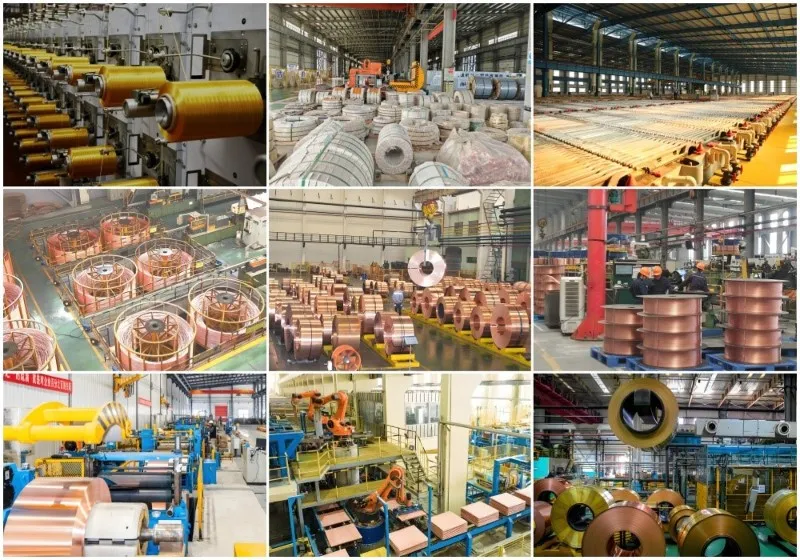
Factory Equipment for Copper
Casting furnaces for pure copper melting
Rolling mills for sheet and plate production
Extrusion presses for rod and bar shapes
Drawing machines for wire and tube production
Annealing furnaces for softening
Quality control lab with spectrometers and testing equipment
CNC cutting and machining equipment for custom sizes