


As a special welding material, titanium welding wire has excellent mechanical properties, corrosion resistance and high-temperature stability due to the addition of titanium, which makes it widely used in many fields such as aerospace, chemical and medical. Titanium welding wire is not only suitable for general welding tasks, but also performs very well in specific demanding environments.
First, the main application areas of titanium welding wire
1. Laser filler wire welding
Titanium welding wires show good weld-forming ability in laser fillet welding, especially in the welding of TC4 titanium alloy plates, and can obtain a flat and high-quality weld seam. The advantages of laser fillet welding include high precision, low heat-affected zones and fast welding speeds, making it suitable for precision joining of high-end materials.
2. Underwater welding
Laser fillet welding of titanium alloys has been successfully applied to underwater welding. Due to the excellent corrosion resistance of titanium alloy itself, the corrosive water in the underwater environment has less effect on the weld. After optimizing the welding parameters, titanium welding wire can achieve high-quality underwater welds, especially in ocean engineering and submarine equipment repair, which is of great significance.
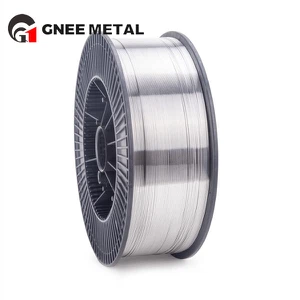


3. Aerospace
In the aerospace field, titanium welding wire is used for the filler welding of turbine disks and blades of jet engines, as well as the welding of the magazine. Titanium alloy is an indispensable material in the aerospace field due to its high strength, light weight and high temperature resistance. The advantage of titanium wires in these applications is the ability to maintain the high performance of the weldment and ensure stability under extreme conditions.
4. Chemical industry
Titanium welding wire is also widely used in the chemical, pharmaceutical and paper industries. The corrosion resistance of titanium alloy makes it an ideal welding material in the manufacture of chemical equipment, especially in the manufacture of chemical reactors, tanks and other equipment, titanium welding wire can provide long-term corrosion resistance guarantee.
5. Medical industry
Titanium alloy in the biomedical field of increasing applications, titanium welding wire is used in the manufacture of orthopedic implants, dental prostheses, cardiovascular devices and other medical equipment. Titanium material has good biocompatibility, titanium welding wire can effectively ensure the compatibility of the welded parts and human tissue, to avoid rejection.
Second, the performance characteristics of titanium welding wire
1. Mechanical properties
Mechanical properties of titanium welding wire depends on its alloy composition and welding process optimization. By choosing the appropriate wire and process, can significantly improve the overall strength and toughness of the welded joints, especially under high temperature, high pressure environment, the stability of the welded joints is particularly important.
2. Corrosion resistance
Titanium welding wire has excellent corrosion resistance, especially for seawater, acidic solutions and certain chemical media. Titanium welding wire in the alloying elements, such as cobalt (Co), chromium (Cr), nickel (Ni), etc., can effectively improve the corrosion resistance of the welded parts, widely used in chemical engineering, marine engineering and other requirements of very high corrosion resistance.
3. Microstructure control
Titanium wire welding technology can effectively control the microstructure of the weld. In laser filler wire welding, by adjusting the welding parameters, you can accurately control the tissue morphology of the weld center area and the grain size of the heat affected zone, which is essential to improve the welding quality and performance.
Third, the process optimization and challenges of titanium welding wire
1. Optimization of welding parameters
Welding speed, wire feeding speed, laser power and other parameters have a decisive impact on the welding quality of titanium welding wire. Optimization of these parameters can effectively improve the forming quality of the weld, reduce the excessive heat treatment of the heat-affected zone, and ensure the strength and toughness of the welded joint.
2. Pretreatment methods
Before welding titanium welding wire, the steps of beveling, cleaning the welding area, preheating and chemical treatment before welding can effectively improve the welding quality. These steps can remove the oxidized layer, oil and other impurities in the welding area, thus reducing welding defects and ensuring the integrity and reliability of the welded joint.


