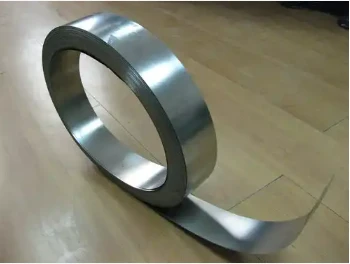


C11000 Equivalent Designations
Before the price discussion, the grade itself. C11000 is electrolytic tough pitch copper (ETP), the workhorse industrial copper grade used in electrical busbar, transformer windings, plumbing tube, general sheet metal, and most rod and wire products. The same chemistry is referenced under several national standards.
| Standard system | Grade code | Other common names | Notes |
|---|---|---|---|
| UNS (USA) | C11000 | Electrolytic Tough Pitch (ETP) | ASTM B152, B187, B49, B280 base grade |
| EN (Europe) | CW004A | Cu-ETP | EN 1652, EN 12163, EN 12449 |
| GB/T (China) | T2 | - | GB/T 5231, GB/T 1527/1530/2040 |
| JIS (Japan) | C1100 | - | JIS H3100, H3200, H3300 |
| DIN (Germany) | 2.0065 | E-Cu58 | DIN 1787 / EN 13601 |
| BS (UK) | C101 | - | BS EN 1652 |
| ISO | Cu-ETP | - | ISO 1336 |
A certificate of analysis should confirm minimum 99.90% copper and residual oxygen in the tough-pitch range. For brazed or hydrogen-atmosphere applications, specify C12200 (DHP) instead; residual oxygen in C11000 can cause hydrogen embrittlement at the joint.
Market Snapshot: October 8, 2026
| Indicator | Latest | Context |
|---|---|---|
| LME 3-month copper | $14,451.50 / tonne | Recovered from holiday low of $14,214 |
| LME 2026 YTD average | $14,370 / tonne | +41% vs 2025 average |
| LME cash vs 3-month | Backwardation ~$5-15/t | Front-end still tight |
| COMEX copper | ~$6.60 / lb (~$14,550/t) | Premium over LME has narrowed sharply |
| COMEX copper stocks | ~700,000 tonnes | Policy-driven inventory remains stranded |
| LME registered stocks | ~243,000 tonnes | Fell 6,425 t during China holiday |
| SHFE 2611 (pre-holiday close) | 109,680 yuan / tonne | - |
| Yangshan copper premium | ~$120 / tonne | Near four-year highs |
| China manufacturing PMI | 50.1 in September | First expansion in three months |
| Chile copper output (August) | 369,500 tonnes | Lowest since February 2011 |
| US core PCE (August) | 3.0% y/y | Lowest since February 2026 |
| US nonfarm payrolls (September) | +29,000 | Far below 90,000 expected |
| CME FedWatch (October) | 79.5% no change | Rate-hike fear has eased |
The Sept 30 "Soft No" and What Changed
The 90-day window for a presidential decision on refined-copper tariffs closed without an announcement. A staged tariff of 15% from January 2027 and 30% from January 2028 had been floated by US agencies, but no proclamation was issued. For the market, this means three things:
The front-loading incentive has weakened. Traders and manufacturers pulled more than 700,000 tonnes of copper into US warehouses in anticipation of duties. With no decision, the urgency to move more metal has faded, and the COMEX-LME premium has narrowed.
The overhang is not resolved. A "soft no" is not a "no." The administration can still announce refined-copper duties later with little warning. That uncertainty keeps US stocks anchored rather than released.
The focus shifts back to physical supply. Once the tariff binary event passed, the market rediscovered the same problems that existed before it: low mine output, negative treatment charges, and thin non-US inventory.
Supply Side: Chile Becomes the New Centre of Attention
Two labour disputes in Chile have replaced the tariff deadline as the dominant supply story.
At the world's largest copper mine, supervisors voted by 95% to authorise strike action on October 1 after rejecting a wage offer. Mandatory mediation is underway, but a legal stoppage is possible if mediation fails.
At another major Chilean operation, workers rejected a final contract proposal by 98.7% and also voted to strike on October 6.
Chile's August copper output fell to 369,500 tonnes, the lowest monthly figure since February 2011 and down 12.8% year-on-year. The country is also structurally short of sulphuric acid, which is required for leach production, and logistical constraints on acid supply have tightened further.
Together, these factors point to a Q4 supply profile that is more constrained than the market assumed in early September. Even if strikes are averted, the underlying output trend is lower.
Demand Side: China Returns to a Tighter Market
China's official manufacturing PMI rose to 50.1 in September, the first expansion in three months, with the production sub-index at a 2026 high of 51.7. The non-manufacturing PMI also recovered to 50.2. The numbers are modest, but they end a string of contractionary readings and set up a seasonal Q4 restocking cycle.
During the October 1-8 National Day holiday, SHFE was closed. LME copper dipped to $14,214 on October 2 as Chinese buyers were absent, then recovered as LME inventories fell by 6,425 tonnes to 242,975 tonnes. That draw occurred while China's exchange was shut, which suggests end-user demand and rest-of-world buying were enough to absorb metal on their own.
For C11000 products tied to Chinese manufacturing - wire rod, strip for connectors, bar for machining, sheet for electrical panels - the post-holiday return matters. If fabricators restart with restocking orders, the tightness visible in Yangshan premiums and SHFE inventories will translate directly into higher conversion premiums.
Q4 Driver Decomposition
The chart below shows the LME price path from September 1 through October 7, with the key events marked. The lower panel breaks down the three forces currently driving the Q4 C11000 outlook.
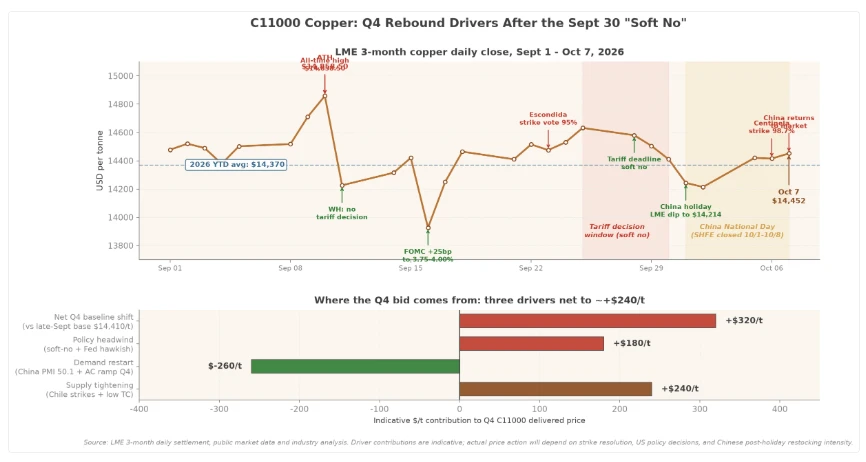
Top: LME 3-month copper daily close, Sept 1 - Oct 7, 2026. Bottom: indicative Q4 contribution of supply tightening, demand restart, and policy headwind to delivered C11000. Source: LME, public market data, industry analysis.
The net effect is mildly bullish for delivered C11000 prices: supply tightening and demand restart together outweigh the policy headwind from the tariff soft-no and the still-hawkish Fed. The indicative baseline shift is on the order of +$200 to +$300 per tonne relative to the late-September base, before any product-specific conversion premium is added.
What C11000 Buyers Should Do Now
Use the post-event calm to negotiate conversion premiums. The tariff headline has passed for now; volatility has dropped. This is a better moment to lock the conversion premium component of a C11000 quote than during the September gap-up.
Confirm your supplier's Q4 availability. With Chilean supply risk rising and Chinese smelters scheduling October-November maintenance, refined cathode availability in Asia will tighten. The metal may be available, but the right form and temper may not.
Watch the strikes daily. A stoppage at either Chilean operation would remove thousands of tonnes per day from a market that has no buffer. The first reliable signal will be LME cash-to-three-month backwardation widening and Yangshan premiums rising further.
Do not assume the tariff story is over. A soft no can become a hard yes with a single announcement. If your C11000 shipment is destined for the United States, keep a tariff-adjustment clause in the contract and clarify whether delivery timing falls before or after any potential January 2027 step.
Separate LME risk from premium risk. Consider a pricing structure that floats the LME component but fixes the conversion premium. The conversion premium is where supplier relationships and scheduling flexibility matter; the LME component is where the macro volatility lives.
C11000 Product Range and Typical Specifications
We supply C11000 across the full industrial form range. Standard specifications are below; non-standard sizes, tempers, and tighter tolerances are available on request.
| Product form | Standard sizes | Temper range | Applicable standards | Common applications |
|---|---|---|---|---|
| Copper tubes | OD 3–219 mm, wall 0.3–10 mm | O60, H55, H80 | ASTM B88, B280, B111; EN 1057, EN 12449 | Plumbing, HVAC, refrigeration |
| Copper plates & sheets | Thickness 0.4–150 mm, width up to 3,000 mm | O60, H00, H02, H04 | ASTM B152, B187; EN 1652 | Busbar, switchgear panels, heat spreaders |
| Copper bars & rods | Diameter 3–400 mm (round, square, hex) | O60, H02, H04 | ASTM B49, B133, B301; EN 12163 | Machined parts, electrical connectors |
| Copper wires & rods | Diameter 0.05–12 mm | Soft and hard drawn | ASTM B1, B2, B3, B8; IEC 60228 | Power cable, magnet wire, grounding |
Volatility Falls, But Tightness Remains
The immediate binary risk around the September 30 deadline is gone, and prices have settled into a $14,200-$14,500 range. That range is not cheap by historical standards, but it is also not fragile. The floor is being supported by low visible inventory outside the United States, falling Chilean output, and the possibility of strike-related disruptions. The ceiling is capped by high US stocks, a hawkish Fed, and the lingering possibility that tariff policy could reverse again.
For C11000 buyers, the shift from a policy-driven market to a physical-driven market is positive in one respect: the price action becomes easier to read. Watch LME inventories, Yangshan premiums, and Chilean labour news. If those three indicators tighten together, the next move is more likely to test the September high than to break the October low.
Request a C11000 Quote
Send us your specification, quantity, and delivery destination. We will return a fully itemized C11000 quote with LME reference, regional premium, and conversion premium separated.