


Price Snapshot, October 8, 2026
| Product | Price (CNY / kg or CNY / tonne) | vs. 30 Sep |
|---|---|---|
| Sponge titanium 0# | 45,000 / tonne | 1,500 higher |
| Sponge titanium 1# | 44,000 / tonne | 500 higher |
| Sponge titanium 2# | 43,000 / tonne | 0 (flat) |
| Titanium ingot TA1 | 55 / kg | 0 (flat) |
| Titanium ingot TA2 | 54 / kg | 0 (flat) |
| Titanium ingot TC4 | 63 / kg | 0 (flat) |
| Plate TA2 6 mm | 77 / kg | 0 (flat) |
| Plate TA2 0.5 mm | 170 / kg | 0 (flat) |
| Plate TC4 15 mm | 140 / kg | 0 (flat) |
| Plate TA15 1.5 mm | 375 / kg | 0 (flat) |
| Plate TA18 1 mm | 430 / kg | 0 (flat) |
| Bar TC4 Φ26 | 140 / kg | 0 (flat) |
| Bar TC4 Φ100 | 115 / kg | 0 (flat) |
| Bar TA2 Φ111 | 105 / kg | 0 (flat) |
| Strip / foil TA1 0.05 mm | 900 / kg | 0 (flat) |
| Strip / foil TA1 0.2 mm | 175 / kg | 0 (flat) |
| Titanium dioxide, rutile | 12,800 – 15,200 / tonne | 0 (flat) |
| Magnesium ingot | 15,750 / tonne | 0 (flat) |
Only the sponge number moved. Every downstream grade, plate, bar and strip held its line. That is the puzzle of the week: sponge bounced, downstream did not, and the gap between the two is the bargaining range that buyers and sellers are now negotiating over.
The Headline Was a Bounce. The Story Is a Ladder.
Sponge titanium 0# rose 1,500 yuan per tonne in a single session, from 43,500 at the close on 30 September to 45,000 on 8 October. That is a 3.4% move in a market that had been flat for five weeks. The bounce is real. The read for a buyer of finished titanium is that nothing downstream moved at all: TA1 ingot held at 55 yuan/kg, TA2 at 54, TC4 at 63, the entire plate table is flat, the entire bar table is flat, the strip and foil table is flat. The reason is straightforward. Ingot and mill-product prices are set on weekly contract negotiation cycles, and a single-day sponge move is a single data point. Most mills have not yet passed through the bounce, and most are watching to see whether it holds before adjusting.
The more durable story is not the bounce. It is the specification ladder - the multi-rung pricing structure that already exists across the titanium product set and that determines what each part of a buyer's bill of materials actually costs. Six ladders are operating simultaneously: by grade, by thickness, by diameter, by product form, by gauge, and by end-use specification. Each produces a different multiplier. Together, they explain why a "1,500 yuan bounce in sponge" can be the smallest line item in a buyer's Q4 cost review.
Six Ladders, Six Multipliers
Ladder 1 - Grade: same thickness, very different money
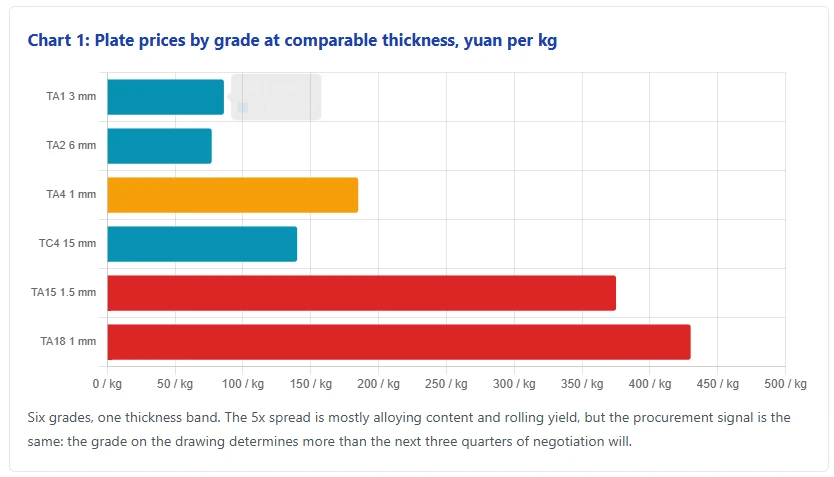
Compare plate at 1 mm thickness across the standard commercial grades. TA1 sits at 86 yuan/kg, TA2 at around 110 yuan/kg, TA4 at 185 yuan/kg, TC4 (15 mm, the standard reference) at 140 yuan/kg, TA15 (1.5 mm) at 375 yuan/kg, and TA18 (1 mm) at 430 yuan/kg. The range from TA1 to TA18 at comparable geometry is roughly 5x. The decision between "we need corrosion resistance against sea water" and "we need high-temperature strength for a ducting flange" is, in cost terms, the same as the decision between TA1 and TA18. That decision is a design decision, not a procurement one - and the procurement team usually only sees it after it has been made.
Ladder 2 - Thickness: the cost lever you control
Walk down the TA2 plate table. 6 mm is 77 yuan/kg, 5 mm is 85, 2 mm is 95, 1.5 mm is 105, 1.0 mm is 110, and 0.5 mm cold-rolled is 170. The 6 mm to 0.5 mm spread is 2.2x. The price step from 6 mm to 5 mm (one gauge) is 10%. The step from 0.5 mm to 0.2 mm strip is 95 yuan/kg. The step from 0.2 mm to 0.05 mm foil is 725 yuan/kg. The mechanism is yield: each rolling pass costs material, time, and anneal/pickle cycles, and the last 90% of thickness reduction eats more input than the first 90%. The procurement implication is to ask, for every plate order, whether the gauge can be relaxed by one step. One step in gauge is the single largest cost reduction available without changing the grade.
Ladder 3 - Diameter: bigger is cheaper, and how much cheaper
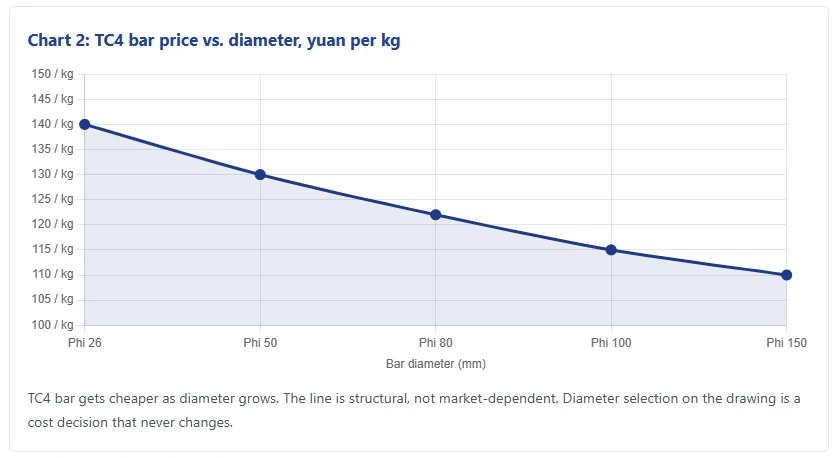
The TC4 bar table tells a different story. TC4 bar at Φ26 mm is 140 yuan/kg. At Φ100 mm it is 115. The diameter multiplier is 0.82x (i.e., 18% cheaper per kg at the larger size), driven by the higher conversion yield of larger billets. The rule of thumb across titanium bar is: every 25 mm of diameter reduction below 100 mm costs roughly 10% in unit price.
Ladder 4 - End-use specification: the hidden premium
Industrial, medical and aerospace specifications sit on the same base metal but pay different premiums. ASTM B265 (commercial plate) at TA2 6 mm trades at 77 yuan/kg. The same plate meeting tighter flatness, surface finish and ultrasonic testing requirements for chemical-process equipment trades 8-12% higher. The same plate meeting tighter chemistry, traceability and vacuum-arc-remelted feedstock for surgical implants trades at multiples of 2-3x. The procurement read: the specification on the purchase order is a hidden price driver. Every additional clause (cert, test, traceability) is a price step. Audit the spec clauses on every long-standing frame agreement, and remove the ones that are no longer required by the current end use. This is the highest-yield, lowest-friction lever in the buyer's toolkit.
Why Titanium Dioxide Did Not Bounce - and the Cost Base Did Not Move Either
Titanium dioxide, the largest end-use of titanium feedstock by volume, did not bounce with sponge. Rutile-grade TiO2 is holding at 12,800-15,200 yuan per tonne, anatase at 12,300-13,200, and chloride-process TiO2 at 15,500-16,800, with the spot picture described as "tidying up and steady." Industry operating rates for September came in near 71%, about two points below last year, and a coordinated round of price-increase notices earlier in the quarter has only shifted the lower end of the range up by 200-300 yuan. Inventory has moved from producers to traders and downstream channels, not into consumption. Three input prices sit underneath every titanium product on the market, and none of them moved this week either: magnesium ingot held at 15,750 yuan per tonne (the reducing agent in the Kroll process, accounting for 12-15% of sponge cost), titanium slag held at 5,200-5,400 yuan per tonne, and ferrotitanium (FeTi-70A) held at 26,750.
The cost floor beneath the entire titanium product set did not move this week. The market has a higher quote and the same cost base. That gap closes in one of two ways: either sponge drifts back toward 44,000 within a few weeks as the restock absorbs, or downstream mills raise ingot and plate quotes in the next 2-3 weeks to capture the sponge move. The first is more likely if industrial demand stays soft. The second is more likely if aerospace or defence orders accelerate into Q4. The sponge bounce is not a new trend. It is the first day of a new restock cycle against an unchanged fundamentals picture.
Procurement Playbook for the First Two Weeks of October
Three moves in priority order. First, do not over-react to the headline. A 1,500-yuan sponge move against an unchanged cost base and an unchanged downstream product set is not a 3.4% cost increase on the parts you actually buy. Most spend is in mill products (plate, bar, tube, wire, strip), and those prices did not move. Second, run a one-week audit on grade and gauge on every open plate order. The largest controllable lever in titanium procurement is grade substitution (move from TA18 to TC4 if temperature allows), gauge relaxation (move one step thicker where the design allows), and diameter relaxation (move one size up on bar where the stress allows). The savings from one round of these reviews is typically 8-15% on the parts that get redesigned, with no supplier negotiation needed. Third, price the next sponge contract at the restock-driven level, but write the contract so that it re-prices if sponge falls back below 44,000 within four weeks. A short-dated clause that re-anchors to the spot average is the cleanest way to participate in a bounce without taking the downside risk of a return to 43,000.
What Would Change the View
Two signals to watch over the next three weeks. If sponge 0# holds above 45,000 for two consecutive weeks, the restock-driven bounce is becoming a real demand pull, and ingot quotes will follow. The next round of mill-product contract negotiations in mid-October will be the first test. If downstream operating rates at major industrial-titanium consumers (chemical-process equipment, marine, heat exchangers) hold below 55% through the end of the month, the bounce stalls and sponge re-tests 44,000. In that case, the right move is to hold the mill-product contract re-pricing clause, and let the market re-anchor.
Standard Product Specifications Available Now
| Form | Grades | Size Range | Standards |
|---|---|---|---|
| Titanium tubes | Gr1, Gr2, Gr3, Gr7, Gr9, Gr12 | OD 6-219 mm, WT 0.5-25 mm | ASTM B338, B861, AMS 4941 |
| Titanium plates & sheets | Gr1, Gr2, Gr5, Gr7, Gr9, Gr12, Gr23 | Thickness 0.3-100 mm | ASTM B265, AMS 4911, AMS 4900 |
| Titanium bars & rods | Gr1, Gr2, Gr5, Gr9, Gr12, Gr23 | Φ 3-300 mm | ASTM B348, AMS 4928, AMS 4930 |
| Titanium wire | Gr1, Gr2, Gr5 | Φ 0.05-8.0 mm | ASTM B863, AMS 4951 |
| Titanium strip & foil | Gr1, Gr2 | 0.02-0.5 mm × 50-600 mm | ASTM B265, GB/T 3622 |
Send your drawing, your grade specification, and the volume profile. We will return a quote that distinguishes the cost of base material from the cost of conversion, so you can see exactly where the ladder starts in your bill of materials.


