

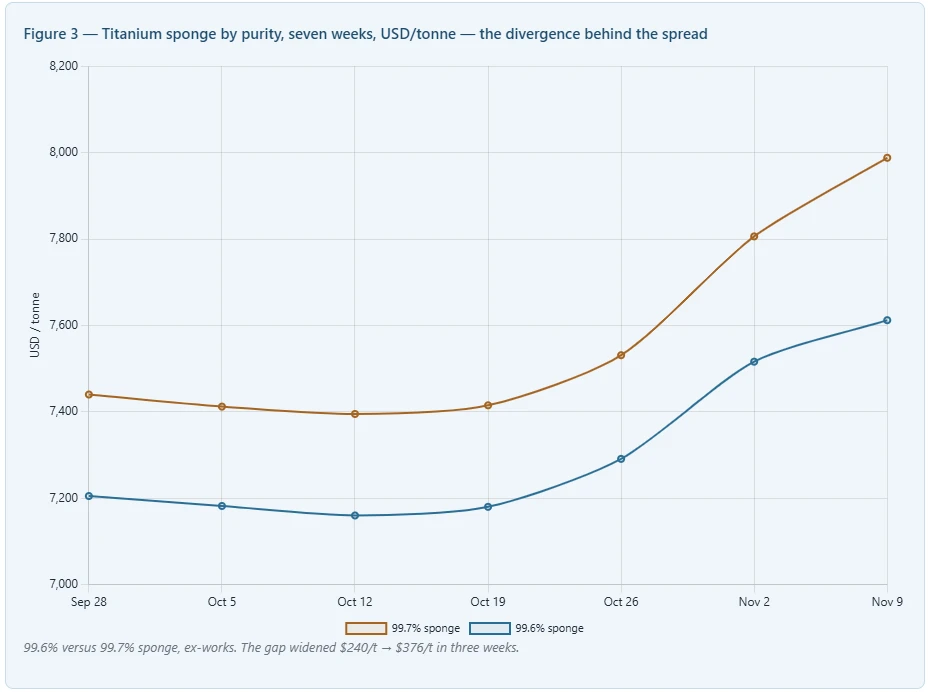
Grade 1 plate closed the week at $24.15 per kilogram, up $0.78 (+3.34%). Generic Gr2 rose just 1.66%, so the gap between the two commercially pure workhorses - $0.54/kg on November 2 - is now $0.94/kg, a 74% widening in seven days. The cause is feedstock: Grade 1 melts from 99.7% sponge, up 2.33% to $7,988/tonne, against 1.28% for the 99.6% material feeding generic Gr2. That turns a specification decision into a priced one - pay $0.52/kg for a negotiated low-oxygen Gr2 clause and wait two to three extra melt weeks, or pay $0.94/kg for Grade 1 and get a guaranteed 0.18% oxygen ceiling with no negotiation. Whether the $0.42/kg between those doors is worth it depends on your drawing - Grade 1's tensile minimum is 240 MPa.
Price Snapshot - Grade 1 Titanium, Week Of November 9, 2026
| Indicator | Reading | Unit | vs. November 2 | Direction |
|---|---|---|---|---|
| Titanium sponge (≥99.6%, ex-works) | 7,612 | USD / tonne | +96 / +1.28% | Third gain, momentum halved |
| Titanium sponge (≥99.7%, ex-works) | 7,988 | USD / tonne | +182 / +2.33% | Gr1's feedstock - still leading |
| 99.7% vs 99.6% purity gap | 376 | USD / tonne | from 290 | Widened three weeks straight |
| Ferro-titanium (FeTi 30) | 1,769 | USD / tonne | +27 / +1.55% | Now faster than sponge - scrap tightening |
| Gr1 plate (ASTM B265, 3–50 mm) | 24.15 | USD / kg | +0.78 / +3.34% | Fastest CP move this week |
| Gr1 tube, seamless (ASTM B338) | 27.58 | USD / kg | +0.75 / +2.80% | Metal-led; bar $23.44, strip $26.35, wire $29.28 in Figure 1 |
| Gr1 tube, welded (ASTM B862) | 23.38 | USD / kg | +0.42 / +1.83% | $4.20/kg under seamless |
| Gr1–Gr2 spread (plate; Gr2 at $23.21, +1.66%) | 0.94 | USD / kg | from 0.54 | +74% in one week - widest in series |
| Low-oxygen Gr2 premium (O 0.13–0.16%) | +0.52 | USD / kg | from +0.58 | Widening stalled - demand shifting to Gr1 |
| Gr1 melt-slot adder / quote validity | +3–4 wks / 5 days | weeks / days | from +2–3 / 5 | 99.7% sponge slots scarce; generic Gr2 validity now 7 days |

What Is Grade 1 Titanium?
Grade 1 (UNS R50450) is the purest, most ductile commercially pure titanium grade. Its strength comes from interstitial oxygen and iron, and it sits at the lowest end of both - which is why it forms, spins and draws better than any other titanium grade. It is the default for deep-drawn shells, bellows and explosive-clad liners. The trade-off is strength: tensile 240 MPa minimum against Gr2's 345, yield 170 against 275, elongation 24% against 20% - every substitution must be checked against the drawing.
| Element | Limit | What it actually does |
|---|---|---|
| Oxygen (O) | 0.18 max | Guaranteed ceiling 0.07 points below generic Gr2 - in the specification, not in a negotiation |
| Iron (Fe) | 0.20 max | Tighter than Gr2's 0.30 - fewer Ti-Fe particles, cleaner in hot chloride |
| Nitrogen / Carbon / Hydrogen | 0.03 / 0.08 / 0.015 max | N counts double in oxygen equivalent; H is the hydride former |
Two boundaries. Gr1 is more formable, not more corrosion-resistant - all CP grades share the same passive film, so the spread buys ductility, not corrosion performance; dry chlorine, anhydrous methanol and hot reducing acids remain outside the envelope. And strength margin must be proven: a section sized on Gr2's 275 MPa yield has only 45% headroom over Grade 1's 170 MPa, and none where the drawing states 345 MPa tensile.
Grade 1 Equivalent Grades
| System | Designation | What it adds beyond "ASTM B265 Gr1" |
|---|---|---|
| UNS | R50450 | Universal key - put it on the RFQ |
| ASTM - product specs | B265 / B348 / B338 / B861 / B862 / B863 / B381 Gr1 | B338 tube adds eddy-current or hydrostatic test |
| ASTM - implant | F67 Gr1 | Microstructure rating, tighter docs - never quote B265 to an implant RFQ |
| ASME | SB-265 / SB-348 / SB-338 Gr1 | Section II docs for coded vessels |
| EN / DIN | 3.7025, Ti1 | EN 10204 3.1 certificate is the default deliverable |
| GB / China | TA1 (GB/T 3620.1) | Close, not identical - see trap 1 below |
| JIS | Class 1 (TR170C) | Yield band, not tensile minimum - trap 3 |
| AMS | AMS 4901 / 4920 | Adds surface and microstructure control |
| AWS filler metal | ERTi-1 (AWS A5.16) | Correct Gr1 filler - not ERTi-2 |
GB TA1 is not a drop-in for ASTM Gr1. The nitrogen ceiling and residual clause differ - a heat can pass GB/T 3620.1 and still miss ASTM B265. Require actual O, N, H and Fe values on the certificate, not pass/fail.
Never accept "low-oxygen Gr2" as Gr1. A generic Gr2 heat can carry up to 0.25% oxygen - above Grade 1's 0.18% ceiling - and its certificate is a Gr2 certificate. Either direction breaks the paper.
JIS "Class 1" is a yield band. TR170C means 170 MPa yield, and plate and tube classes can carry different tensile bands under the same class number - quote class and tensile symbol together.
Why Gr1 Outran Gr2 By 40 Points Of Spread
The $0.40/kg widening decomposes cleanly. +$0.31 is the metal leg: Gr1's metal share (~55% of the quote) prices off 99.7% sponge at +2.33%, not the +1.28% generic Gr2 felt. +$0.32 is allocation pull: medical, aerospace and cladding contracts fill 99.7% melt slots first, while formability-critical Gr2 buyers switching to Gr1 add demand. +$0.15 is conversion capacity - cold-roll and draw slots for the thin-gauge work Gr1 dominates. Total: $23.37 → $24.15/kg, +3.34%.
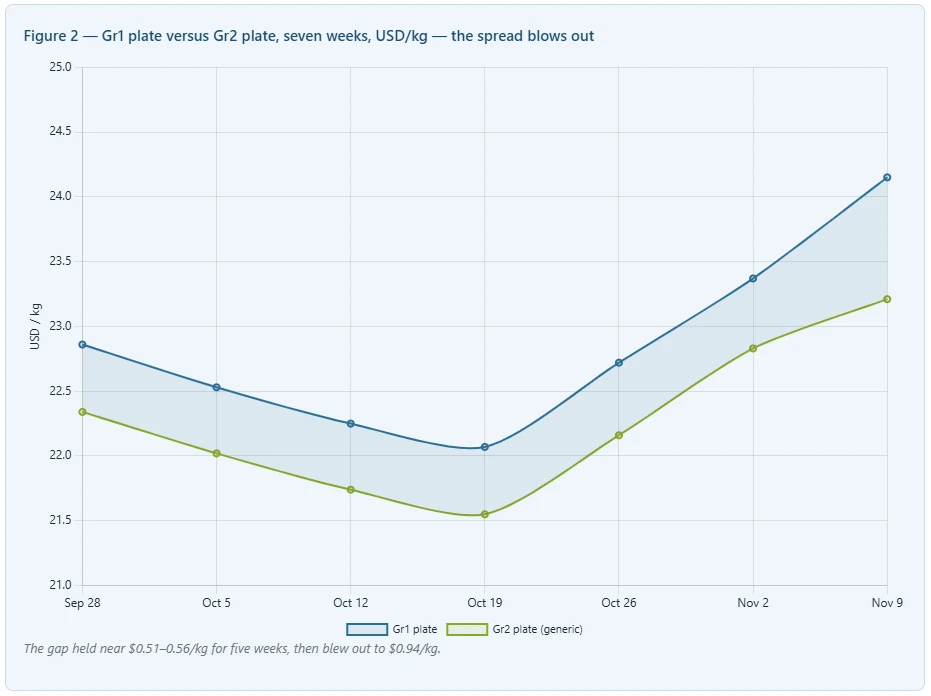
Two consequences. The low-oxygen Gr2 premium stopped widening, easing from $0.58 to $0.52 - buyers who used to bid for that clause now buy Grade 1 outright. And quote validity split by grade for the first time: seven days on generic Gr2, still five on Gr1 - the standard end is cooling while the clean end is not.
The $0.42/kg Question: Pay The Grade Or Pay The Clause
For formability there are two doors, and the arithmetic is explicit. Door one: a negotiated low-oxygen Gr2 heat - +$0.52/kg over generic, a two-to-three week melt-slot adder, a premium that moved 38% in a single week. Door two: Grade 1 - +$0.94/kg, a guaranteed 0.18% oxygen ceiling written into the grade, no negotiation, a three-to-four week adder. The gap is $0.42/kg - $840 on a 2-tonne release - and it buys a ceiling instead of a bid.
| Option | USD/kg vs generic Gr2 | Oxygen you get | Tensile min. | When it is the right door |
|---|---|---|---|---|
| Generic Gr2 | base | 0.25% ceiling (no floor) | 345 MPa | Flat, unformed, ambient service |
| Low-O Gr2 clause | +0.52 | 0.16% max, negotiated | 345 MPa | Formed parts that must also meet a 345 MPa drawing callout |
| Grade 1 | +0.94 | 0.18% ceiling, guaranteed | 240 MPa | Deep drawing, spinning, bellows; drawings allowing 240 MPa |
The deciding test is the drawing, not the price list. If the drawing states 345 MPa tensile, Grade 1 is not an option at any spread - take the clause and pay the wait. If the section has strength margin and the operation is a draw or a spin, Grade 1's guaranteed ceiling is worth the $0.42/kg while the clause premium keeps moving. Either way, put the oxygen limit on the first RFQ.
Three Grade 1 Decisions Worth Money This Week
Buy the melt slot before the metal. The Gr1 adder is now three to four weeks and rising faster than the $0.78/kg - if a Gr1 part is on your Q1 horizon, reserve the melt now and price later. Add the free certificate lines: actual O, N, H and Fe values on the EN 10204 3.1 certificate, heat analysis not product analysis only, UNS R50450 beside the grade name.
Split the commercial terms by grade, not by order. Fix ten-day validity in writing, a price-at-shipment ceiling capped at +5% beyond eight weeks, and release split by lead time - plate and bar six to nine weeks, seamless tube eight to twelve, welded five to seven. On tube, B862 welded Gr1 at $23.38/kg runs $4.20/kg under seamless - the largest form-level saving this week.
Forming, Welding And Machining Notes For Grade 1
Forming: bend radius 1.2–1.5 × thickness, deep-draw limiting ratio 2.2–2.4, but springback runs two to three times mild steel. Welding: GTAW with ERTi-1 filler, argon on face and root; silver or straw, or cut it out. Remove alpha case above 600 °C. Clean CP-1 swarf returns $2.20–$3.10/kg - highest in the CP family.
Where These Numbers Could Reverse
FeTi is the leading indicator: at +1.55% against sponge's +1.28%, ferro-titanium outpacing sponge signals scrap tightening, and the 99.7% line leads the next round. Generic Gr2 validity stretched from five to seven days - if Gr1 validity follows, the allocation pull ends and the $0.94 spread compresses fast. Magnesium has gone flat after its 8.15% shock, and welded tube at $4.20/kg under seamless caps the seamless side.
Grade 1 Titanium Product Range And Specifications
| Product | Standard | Size range | Condition / finish |
|---|---|---|---|
| Titanium plate | ASTM B265 / ASME SB-265 / AMS 4901 | 3–50 mm thick; width to 2,000 mm; length to 6,000 mm | Hot-rolled, annealed, pickled or ground |
| Titanium sheet / strip / coil | ASTM B265 / ASME SB-265 | Sheet 0.5–3 mm, width to 1,220 mm; strip 0.05–3 mm, width 10–600 mm | Cold-rolled, annealed or bright annealed |
| Titanium bar / rod | ASTM B348 / ASME SB-348 / AMS 4920 | Ø 6–200 mm round; hex and square on request; to 6,000 mm | Hot-rolled, turned, peeled or ground; annealed |
| Titanium tube, seamless & welded | ASTM B338 / B861 / B862 / ASME SB-338 | Seamless OD 6–114 mm, wall 0.5–8 mm, to 12,000 mm; welded wall 0.5–4 mm | Cold-drawn or welded, annealed; bright annealed for heat-exchanger duty |
| Titanium wire | ASTM B863 / AWS A5.16 | Ø 0.1–6 mm; coil or spool | Drawn, annealed; bright annealed; ERTi-1 spooled for welding |
| Category | Detail |
|---|---|
| Grades supplied | Gr1, Gr2, Gr3, Gr4, Gr5, Gr7, Gr9, Gr12, Gr23 ELI; GB TA1, TA2, TA4, TC4. Gr1 O ≤0.18% and Fe ≤0.20% guaranteed by specification; low-O Gr2 (O 0.13–0.16%) and custom O/Fe caps against clause |
| Melting & processing | VAR double or triple melt from 99.7% sponge lots, full heat traceability; rolling, forging, deep drawing, spinning, bellows forming, explosive cladding, annealing, pickling, slitting |
| Testing & certification | Full interstitial report (O, N, H, Fe, C actual values), tensile, bend, ultrasonic per ASTM B594, eddy current and hydrostatic per ASTM B338; EN 10204 3.1 standard, 3.2 with witness available; ASME SB- with Section II documentation |
| Lead time | Plate and sheet 6–9 weeks (stock sizes 2–4); bar 5–8; seamless tube 8–12; welded tube 5–7; strip 6–9; wire 6–10. Gr1 melt-slot adder currently 3–4 weeks |
| Packing & terms | VCI paper, sealed plywood crate, ISPM 15 timber; EXW–DDP. Scrap credit on sorted CP-1 swarf: $2.20–$3.10/kg |
Buying Grade 1 this quarter? Send the drawing and annual quantity and we will confirm whether the part belongs in Gr1 or a low-oxygen Gr2 - actual O, N, H and Fe values on every EN 10204 3.1 certificate, melt slot booked at purchase order.