


What changed in the week ending October 10, 2026.
Sponge 0# slipped from RMB 44,000–45,000 to RMB 43,000–44,000, a further 2.2–2.3% off the post-holiday top. Sponge 1# is at RMB 42,000–43,000; sponge 2# is at RMB 41,000–42,000. Rutile R-996 moved from RMB 14,200–14,500 to RMB 14,500–14,800 ex-works, a single RMB 300/tonne adjustment that absorbed a hike letter issued the week before. Titanium concentrate out of Hebei and Panzhihua eased by RMB 30–50/tonne. Downstream aerospace and defence specifications held firm across plate, bar, tube and foil.
Sponge kept sliding after the holiday bounce
The October 8 print looked like a recovery - sponge 0# rebounded from RMB 43,500 to RMB 45,000 in a single session on the back of post-holiday restocking. By the end of the second week that recovery has unwound, and the headline grade is now trading below where it sat before the holiday. The four-week band tells the story cleanly: 0# peaked at RMB 45,000–46,000 in mid-September, slipped to RMB 44,000–45,000 by September 28, broke to RMB 43,000–44,000 by October 8, and is now sitting at the bottom of that range.
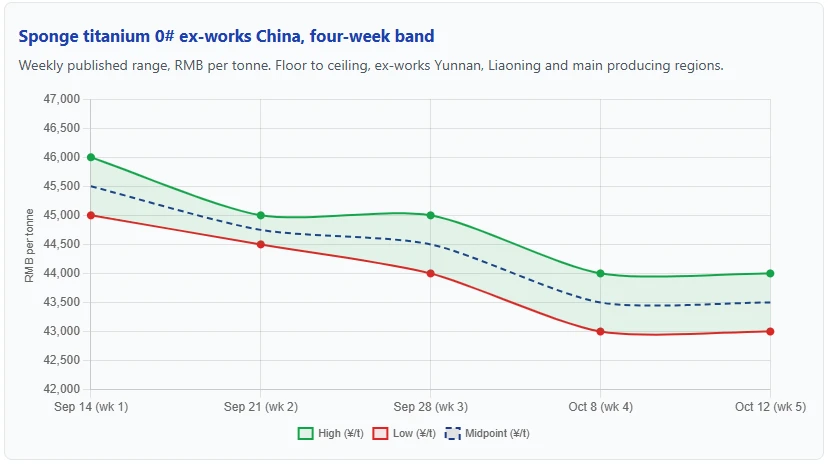
The lower grades followed. Sponge 1# lost RMB 1,000 to land at RMB 42,000–43,000; sponge 2# lost RMB 1,000 to land at RMB 41,000–42,000. The 0#–1# differential holds at RMB 1,000 and the 1#–2# differential holds at RMB 1,000, which is what it has been for the past six weeks. Translation: the grade-1 to grade-0 premium is exactly what it was before the holiday - there is no panic in the premium structure, only pressure on the headline.
Titanium dioxide R-996 is talking about cost, not demand
On October 9, 2026, the major rutile R-996 producer lifted ex-works pricing by RMB 300/tonne, moving the band from RMB 14,200–14,500 to RMB 14,500–14,800. It is the only meaningfully adjusted number on the titanium value chain this week, and the direction is opposite to sponge. That divergence is the most important read on the tape.
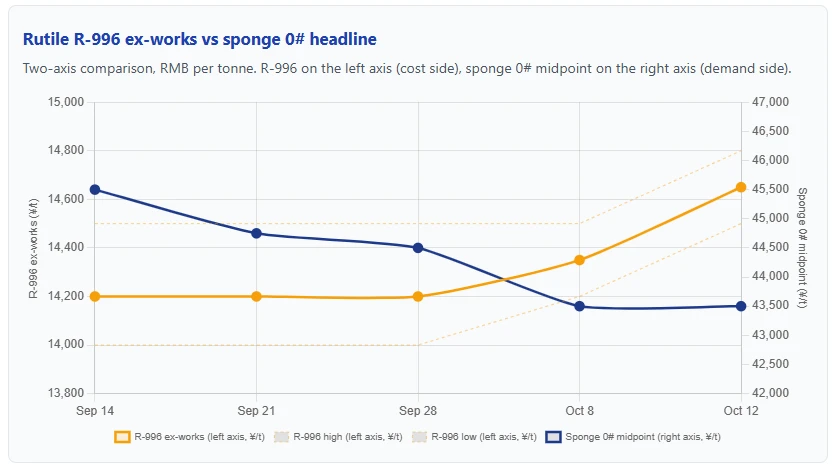
R-996 is a coatings input. Its pricing is governed by titanium concentrate cost (TiO2 >46% Panzhihua at RMB 1,130–1,180, Hebei at RMB 1,020–1,070) and by sulphate-process operating economics. When R-996 goes up while sponge goes down, the implied message is that the cost stack at the front of the chain has stopped falling. Concentrate eased by RMB 30–50/tonne this week, but the downstream producer chose to absorb the cost relief into margin rather than pass it on. A producer who can keep a price hike standing while sponge is dropping is a producer with order-book cover into Q1.
The specification ladder is the only thing still rising
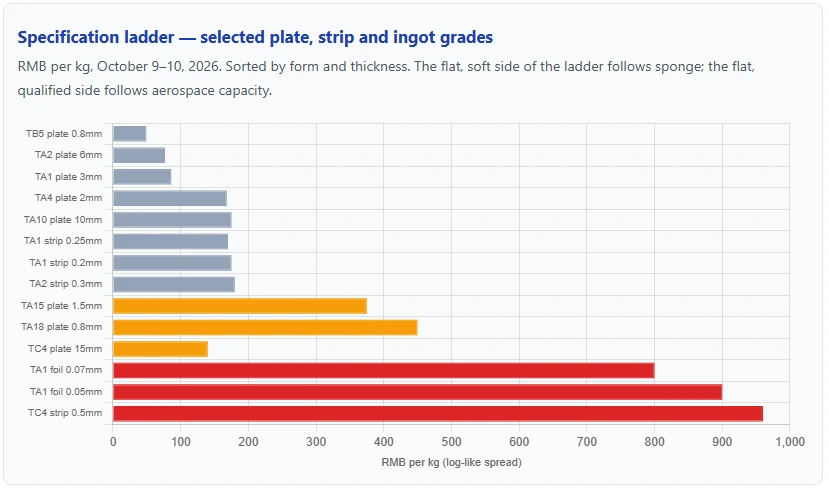
While sponge and R-996 fought over the headline, the mill-product ladder did not move. The table below is compiled from published spot assessments for October 9–10, 2026. Read it the way you would read a price list from your mill, not the way you would read a futures tape.
| Form | Grade | Specification | Price (RMB/kg) | USD eq. ($/kg) | Direction |
|---|---|---|---|---|---|
| Plate | TC4 (Ti-6Al-4V) | 15 mm hot-rolled | 140 | 20.80 | Flat, qualified |
| Plate | TA18 (Ti-3Al-2.5V) | 0.8 mm | 450 | 66.86 | Flat, qualified |
| Plate | TA15 | 1.5 mm | 375 | 55.72 | Flat, qualified |
| Plate | TA4 | 2 mm | 168 | 24.96 | Flat |
| Plate | TA10 | 10 mm | 175 | 26.00 | Flat |
| Plate | TA2 (GR2) | 6 mm hot-rolled | 77 | 11.44 | Flat, soft |
| Plate | TA1 (GR1) | 3 mm | 86 | 12.78 | Flat, soft |
| Plate | TB5 | 0.8 mm | 49 | 7.28 | Flat, soft |
| Strip / coil | TA2 (GR2) | 0.3 mm | 180 | 26.75 | Flat, premium |
| Strip / coil | TA1 (GR1) | 0.25 mm | 170 | 25.26 | Flat |
| Strip / coil | TA1 (GR1) | 0.2 mm | 175 | 26.00 | Flat |
| Strip / coil | TC4 (Ti-6Al-4V) | 0.5 mm cold-rolled | 960 | 142.64 | Flat, scarce |
| Strip / coil | TA1 foil | 0.05 mm | 900 | 133.73 | Flat, specialty |
| Strip / coil | TA1 foil | 0.07 mm | 800 | 118.87 | Flat, specialty |
| Ingot | TC4 | Melting stock | 63 | 9.36 | Flat, qualified |
| Ingot | TA1 | Melting stock | 55 | 8.17 | Flat |
| Ingot | TA2 | Melting stock | 54 | 8.02 | Flat |
| Bar | GR2 | Φ 20–40 mm | 105–110 | 15.60–16.34 | Flat |
| Welded tube | GR2 | OD 6–114 mm | 105–110 | 15.60–16.34 | Flat |
Two observations matter. First, the ladder is steep at both ends. The cheapest spec on the list is TB5 0.8 mm plate at RMB 49/kg; the most expensive is TC4 0.5 mm cold-rolled strip at RMB 960/kg. That is a 19.6× spread within a single metal, and the spread is set by processing yield and qualified capacity, not by sponge. Second, the soft and the scarce have fully decoupled. The soft side of the ladder (TA1 3 mm plate at RMB 86/kg, TA2 6 mm plate at RMB 77/kg, TB5 0.8 mm plate at RMB 49/kg) tracks sponge and the civil-grade inventory. The scarce side (TC4 15 mm plate at RMB 140/kg, TA18 0.8 mm plate at RMB 450/kg, TA15 1.5 mm plate at RMB 375/kg) tracks aerospace and defence qualification. They are two different markets wearing the same metal.
The demand backdrop is still positive - just not for sponge
September manufacturing PMI printed 50.1%, up 0.3 points from August and back above the expansion line. The composition is more useful than the headline. New orders were 50.2, production was 51.0, and the gap between the purchase-price index (60.8) and the factory-gate price index (54.0) sat at 6.8 percentage points - the widest it has been in 12 months. That is a margin squeeze signal, not a demand signal. Mills are paying more for inputs than they are recovering from output, and the way to survive it is to push volume through the highest-margin specifications on the ladder - the qualified aerospace and defence side, not the soft civil side.
Export volumes tell a similar story, with a different centre of gravity. August sponge exports reached 708.4 tonnes, up 23.6% month on month and 32.2% year on year - a five-month high. The export tape has not followed the domestic tape down, which means overseas buyers are still paying full price while Chinese civil demand absorbs the surplus. The export bid is, in effect, the floor under the headline grade. The 8-month cumulative export volume of roughly 4,200 tonnes is 11.3% ahead of the same window last year.
Sponge 0# headline
¥43,000–44,000 /t
−¥1,500–2,000 vs. Oct 8 close
01
Rutile R-996 ex-works
¥14,500–14,800 /t
+¥300 vs. pre-hike (Oct 8)
02
September PMI
50.1%
+0.3 pts vs. August, back to expansion
03
August sponge exports
708.4 t
+32.2% YoY, five-month high
04
What to lock, what to wait, what to re-grade
Three procurement decisions are the only ones that matter this week, and the right answer for each depends on which part of the ladder your part sits on.
Lock now - qualified TC4, TA15, TA18, and TC4 foil. Aerospace and defence lead times remain in the 18–22 month range. Sponge falling does not buy you a faster production slot. If you have a confirmed 2027 delivery, place the order this month; the mill slot is the scarce resource, not the metal.
Wait - civil-grade plate, bar and welded tube. TA1, TA2, GR2 plate, GR2 bar Φ 20–40 mm, GR2 welded tube OD 6–114 mm. The soft side of the ladder is following sponge, sponge has further to give, and concentrate is starting to soften too. Quote your Q1 volume into November; do not pre-commit beyond what you can defer.
Re-grade - any specification that uses TC4 or TA18 when TA2 or GR2 would do the job. The TB5 0.8 mm plate at RMB 49/kg exists because the civil side of the ladder is fully supplied. If your part is corrosion-and-pressure rather than strength-and-temperature, a downgrade in specification can cut material cost by 40–60% with no change in service performance. Re-examine the drawing before you re-examine the price.
Bottom line for week of October 12, 2026. Sponge is talking about weak civil demand. R-996 is talking about firm cost. PMI is talking about squeezed margins. Exports are talking about a foreign bid that has not cracked. All four are true at the same time, which is why the specification ladder is the only signal that reconciles them. The soft side of the ladder still has downside; the qualified side has none.
Request a quote on titanium mill products
Sponge, ingot, plate, sheet, strip, foil, bar, tube and wire in TA1, TA2, GR1, GR2, TC4, GR5, TA15, TA18, TA10 and TB5 grades. Mill test certificates with every order. Standard specifications ship in 3–6 weeks; qualified aerospace specifications confirm against your drawing and heat-number requirements.


