


Price Snapshot - September 28, 2026
Compiled from published weekly spot surveys and daily index prints, September 22–26, 2026.
| Product | China Domestic | Week Move | Signal |
|---|---|---|---|
| Sponge Ti Grade 0# (Liaoning, daily) | ¥44,500/t | Flat (5th week) | Range locked |
| Sponge Ti Grade 0# (Sichuan, daily) | ¥44,500/t | Flat | Range locked |
| Sponge Ti Grade 0# (published range) | ¥44,000–45,000/t | Flat | Avg 44,500 |
| Sponge Ti Grade 1# | ¥43,000–44,000/t | Flat | Avg 43,500 |
| Sponge Ti Grade 2# | ¥42,000–43,000/t | Flat | Avg 42,500 |
| Sponge Ti 0# (FOB China) | $6,800/t | Flat | Export premium persists |
| Titanium tetrachloride (TiCl4) | ¥5,800–6,000/t | Firm | Stock tight |
| Ti concentrate 47% (Panzhihua) | ¥1,170–1,220/t | ↓ low ¥10 | Mild oversupply |
| Ti concentrate 46% (Panzhihua) | ¥1,150–1,200/t | ↓ low ¥10 | Imported ore pressure |
| High-Ti slag 90-grade | ¥5,200–5,400/t | Flat | Loss-making, low op rate |
| Acid-soluble Ti slag (Sichuan) | ¥3,600–3,800/t | Flat | Sluggish |
| TiO2 rutile (ex-works) | ¥15,300–16,800/t | Flat (chloride-route) | Firm, order books into Oct |
| TC4 Alloy Ingot (Ti-6Al-4V) | ¥64,000–66,000/t | Flat | Aerospace full order book |
| TA1 Pure Ti Ingot | ¥55,000–57,000/t | Flat | Stable |
| TA2 Pure Ti Ingot | ¥54,000–55,000/t | Flat | Civil demand soft |
| Ti Plate TA2 (3–8 mm hot-rolled) | 64–68 RMB/kg | Flat | Negotiable |
| Ti Welded Tube (TA1/TA2) | 105–110 RMB/kg | Flat | Civil soft, naval-marine full |
| Pure Ti Bar (Φ20–40 mm) | 105–110 RMB/kg | Flat | Stable |
| TC4 Alloy Bar | 120–125 RMB/kg | Flat | Firm |
| Mill Products - Europe | $13.76–15.20/kg | Elevated | Premium unchanged |
| Mill Products - North America | $6.17–6.81/kg | Stable | Tight availability |
| Mill Products - Northeast Asia | $6.93–7.65/kg | Stable | Steady demand |
Compiled from published weekly spot surveys and daily price index prints, September 22–26, 2026. CNY ex-works China; ore on CIF basis.
Flat On The Surface, Loading Underneath

Sponge Grade 0# published range (shaded band) and mid-point index (line), weekly, mid-July through late September 2026. Index has not broken ±¥200 of mid-range for five weeks.
The published range has not moved in five weeks. The daily index prints from north and southwest producers read within 50,000–200 of each other and within the published band. If you only looked at the headline, you would call this market settled. The weekly surveys describing the market tell a different story. Producer-side commentary now describes a market in stable condition rather than the steady-weak language of two weeks ago - a meaningful if subtle change in tone. Buyer-side commentary continues to describe small-batch, just-in-time restocking and weak willingness to commit on volume. The market is not balanced; it is paralysed, with both sides refusing to be the first to move.
The Export Surge Most Buyers Missed
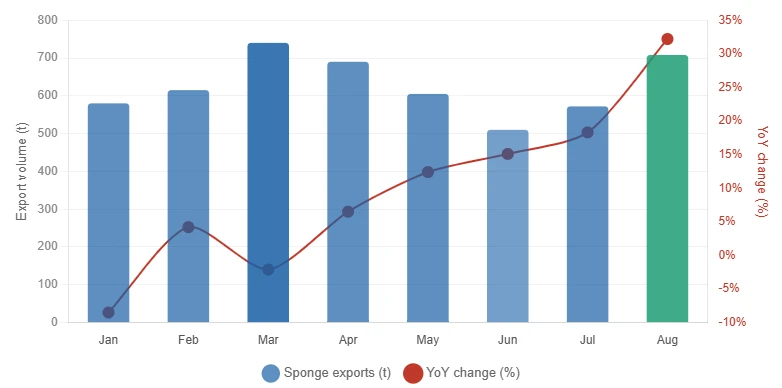
Monthly sponge titanium export volumes, January–August 2026. August exports of 708.4 t were up 23.6% MoM and 32.2% YoY - a five-month high.
The narrative around outbound titanium this year has been dominated by tightening export controls and lengthening documentation timelines. That part is real. What the same data also shows, and what is less discussed, is that volumes have not collapsed - they have rebounded. The August print of 708 tonnes was up 23.6% month-on-month and 32.2% year-on-year, and is the highest monthly figure since March. The first eight months of 2026 are running 11.8% ahead of the same period last year. That is the supply-side story of the month, and it is worth keeping in mind as Q4 sourcing plans are finalised: the tonnage that left the country in August is not available to a domestic buyer today.
Three Quiet Shifts Behind The Flat Range
Northern producers are bringing new capacity online. Surveys describe H2 capacity additions advancing in the north, with units that had been under maintenance restarting one after another. National sponge output is on a measured rising path through the second half. That is the supply-side counterpart to flat demand: even a market with weak restocking absorbs output more slowly when output is rising.
Civil demand is releasing - but from a high inventory base. The latest survey language describes steady release of civil titanium-material demand in September, a meaningful upgrade from the earlier "weak" characterisation. The reason the price has not moved on that improvement is that domestic buyers entered Q3 carrying heavy first-half inventories. Order books at converting plants are filling, but raw-material purchasing is progressing slowly because existing stock is being worked through first.
Exports are absorbing what domestic demand is not. August sponge exports at 708 tonnes were 23.6% above July and 32.2% above last August. Cumulative January–August volumes are running 11.8% ahead of 2025. None of this tonnage comes back. Combined with the rise in domestic output, it means the supply that looks like it is sitting in inventories is, in part, on its way to a port.
The Structural Split Is Widening Again
The aerospace/military tier of the titanium market continues to operate on a different clock from civil-grade materials. The same surveys describe full order books at leading producers for aerospace-grade sponge and bar, with extended delivery times and tight high-end supply. Naval-marine-grade tube orders are filled through the first half of next year. The civil casting-ingot tier, by contrast, is still running at less than 50% operating rates, with low-end products facing fierce price competition and downstream users only making small-batch, just-in-time restocking.
That polarised pattern is unlikely to change in the short term, the commentary notes, and the gap between the two tiers is widening rather than narrowing. The cost floor that supports sponge prices is held in place by the upstream feedstock chain (concentrate, TiCl4, electricity and magnesium), and that floor remains intact this week. The structural message for buyers is unchanged: civil-grade and aerospace-grade titanium no longer respond to the same signals, and treating them as one market is the most common procurement error in the current environment.
The Q4 Procurement Checklist - By Month
This is the calendar your team can work from next week. Adjust to your contract terms and inbound logistics; the point of the list is sequencing.
| Month | Civil-grade sponge | Aerospace-grade TC4 / bar | Watch item |
|---|---|---|---|
| October | Push for range bottom on spot volumes; defer Q1 contracts | Confirm 2027 allocation slots | Whether northern H2 capacity releases on schedule |
| November | Continue spot buying; watch pigment destock cycle | Lock 2027Q1 bar / ingot contracts | TiCl4 tightness; pigment restocking pace |
| December | Year-end inventory reset - avoid carry at ¥44,000/t | Last call for H1-2027 slots | Year-end settlement prices; export volumes |
Working calendar. Treat month boundaries as soft; the point is the order of operations.
Industry Watch - Three Quiet Movers
A recycled-titanium national standard is going live. GB/T 20927–2026, the new national standard for recycled titanium feedstock, takes effect in February 2027. It formally classifies titanium scrap by form - large block, small block and swarf - and brings recycled material into a proper raw-material standard for the first time. The implication for 2027 sourcing: a traceable, standardised recycled stream reduces dependence on primary sponge in loss-making conditions. Producers will have a cheaper alternative to running unprofitable lines.
Smart-factory carbon accounting is becoming standard. A leading domestic titanium producer is tendering a smart-factory platform that includes carbon-footprint accounting as one of ten functional modules - not as an add-on. The practical signal: large mills are preparing to defend EU market access against tightening carbon-border rules by being able to print their emissions data on demand. Buyers who think in five-year contracts should care which suppliers can do that today.
3C titanium demand is pulling forward. With a major consumer-electronics launch cycle approaching, foldable-device hinges, mid-frames and watch cases are pulling free-cutting titanium alloy demand. Industry projections put domestic 3C titanium alloy demand at around 5,000 tonnes in 2027, a market worth roughly ¥30 billion. Spherical titanium powder remains structurally short at ¥350–400/kg, with supply still booked through next year.
What Would Change This View
Civil ingot utilisation re-accelerates above 55%. Surveys describe small and medium ingot plants running below 50%. A rebound in utilisation is the cleanest signal that first-half inventories are finally being worked through.
Pigment restocking translates into concentrate buying. Pigment order books filled into October, but the transmission from pigment restocking into actual concentrate purchases is what thickens the sponge cost floor further.
An aerospace delivery slip. A delay at a major Western OEM frees capacity for non-aerospace buyers and changes the 2027 TC4 picture materially.
Export controls tighten further. If documentation timelines extend, August-style export volumes are harder to repeat, and the tonnage stays in the domestic market - extending the soft price environment.
Product Specifications
Mill-certified titanium products manufactured to international standards. Available in Grades 1–4 (TA1–TA4) and Grade 5 (TC4 / Ti-6Al-4V).
| Product | Grades | Size Range | Standards |
|---|---|---|---|
| Titanium Tubes | Gr1 / Gr2 / Gr3 / Gr5 (TA1 / TA2 / TA3 / TC4) |
OD: 3–114 mm WT: 0.2–5.0 mm Length: up to 18,000 mm |
ASTM B338 ASME SB338 GB/T 3624 |
| Titanium Plates | Gr1 / Gr2 / Gr3 / Gr5 (TA1 / TA2 / TA3 / TC4) |
Thickness: 0.5–100 mm Width: up to 3,000 mm Length: up to 6,000 mm |
ASTM B265 ASME SB265 GB/T 3621 |
| Titanium Bars | Gr1 / Gr2 / Gr3 / Gr5 (TA1 / TA2 / TA3 / TC4) |
Diameter: 3–300 mm Length: up to 6,000 mm Round / Square / Hex |
ASTM B348 ASME SB348 GB/T 2965 |
| Titanium Wires | Gr1 / Gr2 / Gr3 / Gr5 (TA1 / TA2 / TA3 / TC4) |
Diameter: 0.1–6.0 mm | ASTM B348 ASTM F136 / F67 GB/T 3623 |
| Titanium Strips & Foils | Gr1 / Gr2 / Gr5 (TA1 / TA2 / TC4) |
Thickness: 0.03–3.0 mm Width: up to 620 mm |
ASTM B265 GB/T 3622 |
Flat for five weeks, but the tape is loading
H2 sponge output is rising, August export volumes hit a five-month high, and the structural gap between civil and aerospace grades keeps widening. We hold mill-certified stock across tubes, plates, bars, wires and strips, with full export and carbon-border documentation. Send your specification and target volume - response within 24 hours.


