

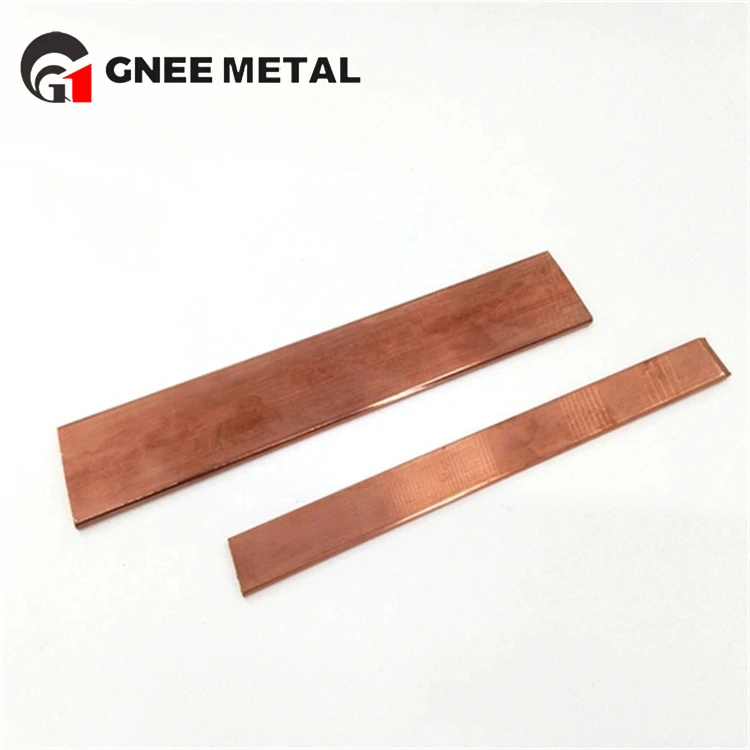
A copper busbar is a conductor made of copper with a rectangular (or nearly rectangular) cross-section. Due to its excellent electrical and thermal conductivity and mechanical strength, it plays a key role in various fields, including electrical, electronics, and construction.
Copper busbars are primarily made of high-purity copper (such as T2 copper, with a copper content of ≥99.9%). Their cross-section is mostly rectangular (common specifications are width × thickness, such as 100mm × 10mm), although a small number of special shapes (such as rounded corners and trapezoidal shapes) are also available. Their surface is typically smooth and burr-free to ensure good electrical contact.
Copper's electrical conductivity is second only to silver, reaching 57ms/m at room temperature (the international standard for annealed copper is 58ms/m), making it suitable for high-current transmission.
With a thermal conductivity of approximately 401W/(m·K), copper busbars can quickly dissipate heat and are often used in applications requiring heat dissipation. In terms of mechanical strength, copper busbars have excellent ductility and bending resistance, making them easy to process and shape. They also offer superior corrosion resistance to metals like iron and aluminum (they are virtually rust-resistant in dry environments, but require surface treatment in humid or acidic environments). In terms of weather resistance, they offer a wide operating temperature range (-40°C to 120°C) and high stability.


Let's take a look at the production, specifications, and standards of copper busbars.
1. Production Process
-Rolling: This is the most common process, where copper billets are rolled into copper busbars of specified thickness and width using a rolling mill. This process offers high precision and a smooth surface.
-Drawing: This is used to produce small-sized copper busbars, formed through a die for more precise dimensions.
-Surface Treatment: Depending on the requirements, copper busbars can be tinned (for oxidation protection and enhanced weldability), galvanized (for corrosion resistance), nickel-plated (for high-temperature resistance), or coated with insulating varnish (for insulation protection).
2. Specifications and Standards
-Size Range: Widths typically range from 10 to 120 mm, and thicknesses from 3 to 12 mm. Custom specifications are available (e.g., extra-thick busbars for high-voltage equipment). - National Standard: China implements GB/T 5585.1, "Copper, Aluminum, and Their Alloy Busbars for Electrical Use - Part 1: Copper and Copper Alloy Busbars," which clearly stipulates dimensional tolerances, conductivity, and mechanical properties (for example, the conductivity of T2 copper busbars must be ≥97% IACS).
- Current Carrying Capacity: The larger the cross-section, the higher the current carrying capacity. For example, a 100mm x 10mm copper busbar has a current carrying capacity of approximately 2500A at an ambient temperature of 25°C (specific current capacity depends on heat dissipation conditions and installation method).
3. Comparison with Other Conductors
- Copper Busbar vs. Aluminum Busbar: Copper busbars have a conductivity approximately 1.6 times that of aluminum busbars, offering higher current carrying capacity and greater mechanical strength, but also come at a higher cost (copper costs approximately 3-5 times the price of aluminum). They are often used in applications requiring high performance.
- Copper Busbar vs. Cable: Copper busbars offer better heat dissipation and are suitable for high-current, low-voltage applications (such as distribution cabinet busbars), while cables are more flexible and suitable for long-distance transmission. The following are the main uses of copper busbars:
1. Power Systems: Core Components for Conducting and Distributing Power
[High and Low Voltage Distribution Cabinets] Serves as busbars (busbars) to connect circuit breakers, transformers, and other equipment, carrying high currents (such as the main busbars within the low-voltage cabinets of substations).
[Busbar Trunk Systems] Replace traditional cables for high-current transmission vertically or horizontally within buildings, offering excellent heat dissipation and easy installation and maintenance.
[Transformer and Motor Connections] Connects transformer low-voltage outgoing wires and large motor stator windings, requiring high conductivity and mechanical strength.
[Grounding Systems] As a grounding busbar, copper's corrosion resistance surpasses that of steel, making it suitable for outdoor or humid environments (such as building lightning protection grounding grids).
2. Electronics and Communications: Precision Conductivity and Heat Dissipation
[PCBs and Integrated Circuits] Used as the conductive layer of high-power PCBs (replacing copper foil) or as a heat sink for chips (leveraging copper's thermal conductivity to quickly dissipate heat).
[Power Supply Equipment] Conductive busbars in inverters and rectifiers, such as those used to connect IGBT modules within photovoltaic inverters, require low impedance and high heat dissipation. [Communication Base Stations] Power distribution buses within cabinets, as well as high-frequency signal transmission (copper's skin effect is superior to aluminum, making it suitable for high-frequency applications).
3. Construction and Engineering: Grounding, Lightning Protection, and Special Scenarios
[Grounding and Lightning Protection] Grounding mains and lightning rod down conductors in high-rise buildings. The conductivity and corrosion resistance of copper busbars ensure grounding reliability (such as subway grounding systems).
[Electroheating Equipment] Conductor buses in industrial heating furnaces, for example, utilize copper's high conductivity and high-temperature resistance.
[New Energy] Connector buses for electric vehicle battery modules (nickel-plated copper buses for vibration resistance and electrolyte corrosion resistance), and high-current conductive components within charging stations.
4. Industrial and Special Equipment: Customized Conductive Solutions
[Electrolysis and Electroplating Equipment] Anode and cathode connector buses for electrolytic cells require high conductivity and electrolyte corrosion resistance.
[High-Frequency Induction Heating] Induction coil buses in metal smelting equipment, for example, utilize copper's low impedance and high-frequency performance.
[Rail Transit] Busbars within high-speed rail traction converters and EMU power distribution cabinets require high reliability and vibration resistance. Finally, let's look at copper busbar selection and application considerations:
[Ampacity Calculation] Select the cross-section based on the current, ambient temperature, and installation method (horizontal/vertical) to avoid overheating.
[Surface Treatment] Choose tinned or galvanized busbars for humid environments, tinned busbars for soldering, and silver-plated busbars for high-frequency equipment.
[Insulation Protection] Exposed copper busbars should be covered with insulating heat shrink tubing or coated with insulating varnish to prevent short circuits.
[Cost Considerations] For large-scale applications, consider copper-aluminum composite busbars (to reduce costs while maintaining performance).
Copper busbars, with their high electrical and thermal conductivity and easy processing, have become irreplaceable conductive components in the power, electronics, and construction industries. From busbars in distribution cabinets to battery connections in electric vehicles, their applications span a wide range of applications, from traditional industries to new energy sources. They are the "blood vessels" of modern electrical systems.
The company has a cluster of leading copper processing production lines in China, including:
German imported precision copper tube production line (annual output of 30,000 tons)
Japanese technology copper foil rolling line (thinnest up to 6μm)
Fully automatic copper bar continuous extrusion line
Intelligent copper sheet and strip finishing mill unit
Digitalized control and management of the whole production process is realized through MES system, and the dimensional accuracy of the products can reach ±0.01mm.