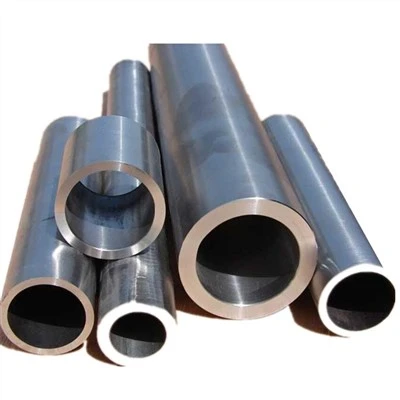


What C10100 Oxygen-Free Copper Pipe Is
C10100 copper pipes consist of 99.99% pure copper and are therefore oxygen-free and highly conductive. Typical mechanical properties are a tensile strength of about 210-275 MPa, a yield strength of about 50-69 MPa and an elongation of 35-50%, all of which vary with temper. Because of its excellent thermal and electrical conductivity, C10100 copper is ideal for high-performance products. The grade also offers high corrosion resistance, good machinability and improved ductility that simplifies fabrication, which together make C10100 pipe suitable for electrical, industrial and vacuum applications where both conductivity and purity must be high.
ASME SB280 C10100 Seamless Pipe Specifications
| Item | Value |
|---|---|
| Standard | ASTM B280 / ASME SB280, with ASTM B75 / ASME SB75 and ASTM B68 / ASME SB68 families for related product forms; ASTM B111 / ASME SB111 for heat exchanger tube |
| Material | Copper, UNS C10100, oxygen-free electronic grade |
| Outside diameter | 4 mm - 150 mm |
| Wall thickness | 0.25 mm - 8 mm |
| Length | 1 m - 6 m, or as required |
| Types | Seamless pipe, light drawn pipe, light annealed pipe, bright pipe, annealed pipe, fully annealed pipe, hard drawn pipe |
| Supply form | Pancake coil, level wound coil, straight length, inner-grooved tube, semi-finished tube |
The usual application routes are pancake coil and level wound coil for air conditioning and refrigeration and general engineering, straight copper pipe and inner-grooved pipe for refrigeration circuits, pipe for transportation systems handling water, gas and oil, and semi-finished pipe for other industrial duties.
Chemical Composition and Physical Properties
C10100 is an oxygen-free electronic grade, meaning both the oxygen content and the residual deoxidant level are tightly restricted so that conductivity stays close to the theoretical maximum and the material remains suitable for vacuum service. The composition limits are given below; values are maximum unless stated otherwise.
| Element | Limit | Element | Limit |
|---|---|---|---|
| Cu | 99.99% min | P | 0.0003% |
| O | 0.0005% | Te | 0.0002% |
| Zn | 0.0001% | Pb | 0.0005% |
| Fe | 0.0010% | Ag | 0.0025% |
The deoxidant chemistry above corrects a common transcription error in which phosphorus, tellurium and residual elements are listed under scrambled column headings. Phosphorus is deliberately kept at trace level because it is a residual deoxidant, while tellurium is restricted as a harmful impurity for conductivity.
| Property | Value |
|---|---|
| Density | 8.94 g/cm3 (0.323 lb/in3) |
| Electrical resistivity at 20 °C | 10.3 microhm-cm |
| Electrical conductivity | 101% IACS |
| Melting point | 1083 °C (1981 °F) |
| Thermal conductivity | 391 W/(m K), equivalent to 226 Btu/(ft h °F) |
| Mean coefficient of thermal expansion | 17.0 micro-m/(m K), equivalent to 9.4 micro-in/(in °F) |
| Modulus of elasticity in tension | 117 GPa (17,000 ksi) |
Working Pressure and Size Data
Maximum working pressures are tabulated separately for three wall-thickness families: Type Y half-hard annealed tube, Type X half-hard light gauge tube and Type Z hard drawn thin wall tube. The following extract shows how the wall thickness and the allowable pressure move in opposite directions as the outside diameter grows.
| Outside diameter (mm) | Type Y pressure (MPa) | Type Y wall (mm) | Type X pressure (MPa) | Type X wall (mm) | Type Z pressure (MPa) | Type Z wall (mm) |
|---|---|---|---|---|---|---|
| 6 | 14.4 | 0.8 | 13.3 | 0.6 | 11.3 | 0.5 |
| 8 | 10.5 | 0.8 | 9.7 | 0.6 | 9.8 | 0.5 |
| 10 | 8.2 | 0.8 | 7.7 | 0.6 | 7.8 | 0.5 |
| 12 | 6.7 | 0.8 | 6.3 | 0.6 | 6.4 | 0.5 |
| 15 | 6.7 | 1.0 | 5.8 | 0.7 | 5.0 | 0.5 |
| 18 | 5.5 | 1.0 | 5.6 | 0.8 | 5.0 | 0.6 |
| 22 | 5.7 | 1.2 | 5.1 | 0.9 | 4.1 | 0.6 |
| 28 | 4.2 | 1.2 | 4.0 | 0.9 | 3.2 | 0.6 |
| 35 | 4.1 | 1.5 | 4.2 | 1.2 | 3.0 | 0.7 |
| 42 | 3.4 | 1.5 | 3.5 | 1.2 | 2.8 | 0.8 |
| 54 | 3.6 | 2.0 | 2.7 | 1.2 | 2.5 | 0.9 |
| 67 | 2.8 | 2.0 | 2.0 | 1.2 | 2.0 | 1.0 |
| 76.1 | 2.5 | 2.0 | 2.4 | 1.5 | 1.9 | 1.2 |
| 108 | 2.2 | 2.5 | 1.7 | 1.5 | 1.7 | 1.2 |
Nominal sizes are also stocked against standard Type K, Type L and Type M inside diameters, which is the fastest way for a designer to match a copper tube to an existing fitting series. A 1/2 in outside diameter, for example, has a Type K inside diameter of 0.402 in (10.211 mm), a Type L inside diameter of 0.430 in (10.922 mm) and a Type M inside diameter of 0.450 in (11.430 mm), the differences reflecting progressively thinner walls. The same pattern continues through 5/8 in, 3/4 in, 7/8 in, 1 1/8 in, 1 3/8 in, 1 5/8 in, 2 1/8 in and 3 1/8 in sizes.
Typical Applications of C10100 Pipe
Electrical bus bars, connectors and low-resistance wiring systems, where the 101% IACS conductivity keeps losses to a minimum.
High-vacuum equipment such as particle accelerators and semiconductor production lines, where oxygen-free purity limits outgassing.
Aerospace and automotive fuel lines and heat exchangers, taking advantage of thermal conductivity together with formability.
Industrial equipment, refrigeration equipment and plumbing, where strength and heat transfer are required at the same time.
Coil and straight tube forms for air conditioning and refrigeration, including inner-grooved tube for evaporator and condenser circuits.
Semi-finished tube stock for further drawing, bending and fabrication in precision equipment.
FAQ
Q: What is the copper content of C10100 pipe?
C10100 copper pipe is made from 99.99% pure copper, which is why the grade is described as oxygen-free and highly conductive.
Q: How much oxygen is allowed in C10100?
Oxygen is limited to 0.0005% maximum, the tightest level among the common oxygen-free copper grades, which enables vacuum and electronic service.
Q: What mechanical properties can I expect?
Tensile strength is about 210-275 MPa, yield strength about 50-69 MPa and elongation 35-50%, with the exact figures depending on temper.
Q: Which size range is available?
Outside diameters from 4 mm to 150 mm with wall thicknesses from 0.25 mm to 8 mm, and lengths from 1 m to 6 m or as required.
Q: How are the maximum working pressures presented?
Pressures are tabulated separately for Type Y half-hard annealed, Type X half-hard light gauge and Type Z hard drawn thin wall tube, for each outside diameter and wall combination.
Q: Why does C10100 suit high-vacuum applications?
Because it is oxygen-free with tightly controlled residual elements, it resists oxidation and outgassing, and it combines high conductivity with good workability for precision parts.