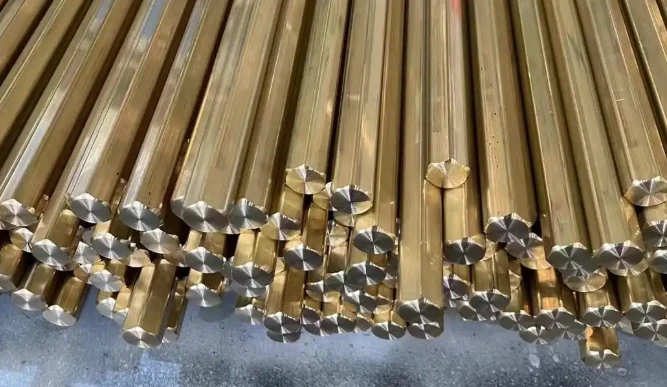
Hexagonal brass rod, as one of the widely used varieties of H62 brass, plays a significant role in numerous fields due to its unique hexagonal cross-section, durable material, and excellent mechanical properties, as well as its superior electrical and thermal conductivity. Hexagonal brass rod is typically an alloy of copper and zinc, inheriting copper's electrical and thermal conductivity while enhancing mechanical properties and corrosion resistance through the addition of zinc. This alloy generally exhibits high hardness and strength, maintaining stable performance under various harsh conditions. This article will provide a comprehensive and in-depth introduction to hexagonal brass rod, covering its basic properties, primary production processes, widespread application scenarios, and usage precautions.
Basic Properties of Hexagonal Brass Rods
Hexagonal brass rods are rod-shaped products primarily made of brass. As an alloy of copper and zinc, brass not only inherits the electrical conductivity and thermal conductivity of copper but also improves its mechanical properties and corrosion resistance through the addition of zinc. This alloy typically has high hardness and strength, enabling it to maintain stable performance in various harsh environments.
In terms of electrical conductivity, while brass's conductivity is slightly inferior to pure copper, it remains sufficient to meet the requirements of most electronic devices. Its thermal conductivity gives hexagonal brass rods a natural advantage in the production of heat dissipation components. Additionally, brass exhibits excellent corrosion resistance, maintaining a smooth surface and resisting rust even in humid, acidic, or alkaline environments.
Main Production Process Flow for Hexagonal Brass Rods
The production process for hexagonal brass rods primarily includes electric furnace melting, component analysis, submerged arc casting, multi-stream multi-head horizontal continuous casting, peeling, and final inspection before shipment.
First, raw materials such as copper and zinc are melted in an electric furnace at a specific ratio. During the melting process, temperature and time must be strictly controlled to ensure the alloy components are uniform and meet standards. After melting, a composition analysis is conducted to verify that the chemical composition of the alloy meets the required standards.
Next, the molten alloy is poured into a multi-stream, multi-head horizontal continuous casting machine via a submerged arc transfer device. The continuous casting machine uses a series of precise control systems to evenly distribute the molten alloy to each casting nozzle, forming a continuous hexagonal brass rod billet. This step not only improves production efficiency but also ensures the dimensional accuracy and surface quality of the billets.
After continuous casting, the billets undergo peeling treatment to remove surface oxide scale and impurities. The peeled hexagonal brass rods must undergo rigorous testing, including measurements of dimensions, hardness, electrical conductivity, and thermal conductivity, to ensure they meet quality standards.
Wide-ranging applications of hexagonal brass rods
Hexagonal brass rods are widely used in various fields due to their excellent properties.
In manufacturing, hexagonal brass rods are commonly used to produce components such as connectors and fasteners for precision mechanical parts. Their high strength and good wear resistance make them critical components in mechanical transmission systems. Additionally, in mold making, hexagonal brass rods are widely used as structural materials.
The electronics industry is another important application area for hexagonal brass rods. Due to their excellent electrical conductivity, hexagonal brass rods are widely used in wire connections for electronic components and circuit board assembly. In electrical equipment, hexagonal brass rods are also highly favored for their corrosion resistance, ensuring stable and long-term operation of the equipment.
In the architectural hardware and decoration industry, hexagonal brass rods are also widely used. They are commonly used to manufacture door and window hinges, handrails, and balustrades, enhancing both the overall aesthetic appeal and durability of buildings. Additionally, hexagonal brass rods have extensive applications in home decoration, such as plumbing fittings and bathroom fixtures.
Furthermore, hexagonal brass rods are utilized in certain specialized chemical reactions due to their corrosion resistance, serving as construction materials for corrosion-resistant reactors. In industries such as shipbuilding, hexagonal brass rods are also employed in the production of fasteners and other components.
Precautions for Using Hexagonal Brass Rods
Although hexagonal brass rods offer numerous advantages, the following precautions should be observed during use:
First, select the appropriate specifications and models. Based on the specific requirements of the application scenario, choose the appropriate specifications and models of hexagonal brass rods to ensure they meet the usage requirements.
Second, pay attention to temperature and speed control during processing. When processing hexagonal brass rods, it is essential to strictly control processing temperature and speed to avoid quality issues such as overheating, overcooling, or deformation.
Additionally, pay attention to the storage and maintenance of hexagonal brass rods. Avoid storing them in harsh environments such as damp or acidic/alkaline conditions to prevent adverse effects on their performance. Regularly clean and maintain the hexagonal brass rods to extend their service life.
The company has a cluster of leading copper processing production lines in China, including:
German imported precision copper tube production line (annual output of 30,000 tons)
Japanese technology copper foil rolling line (thinnest up to 6μm)
Fully automatic copper bar continuous extrusion line
Intelligent copper sheet and strip finishing mill unit
Digitalized control and management of the whole production process is realized through MES system, and the dimensional accuracy of the products can reach ±0.01mm.