Composition: Where the Two Materials Diverge
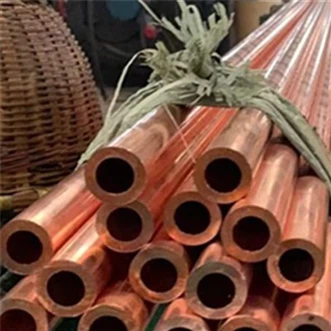
Red copper is close to pure copper. Its copper content is about 99.9% with very few other elements, which produces the characteristic reddish colour and the high conductivity that makes it a reference conductor. Oxygen may be present as a controlled residual in the tough pitch grades, or held below a few thousandths of a percent in the oxygen free grades used for vacuum and electronic service.
Phosphor copper is a copper alloy made by adding phosphorus to the melt, typically in the range of 0.03% to 0.35%, and in the form usually supplied industrially the phosphor bronze grades also carry tin at around 5% to 9%. The phosphorus deoxidises the melt, which improves casting behaviour and gives a cleaner material, while the tin provides the strength and elastic properties. Because the alloying elements are deliberately present, the material no longer behaves like pure copper.
| Feature | Red copper | Phosphor copper / phosphor bronze |
|---|---|---|
| Copper content | 99.9% and above | balance after alloying additions |
| Phosphorus | not intentionally added | 0.03 – 0.35% |
| Tin | absent | about 5 – 9% in bronze grades |
| Typical designation | T2, C11000, C1100 | QSn6.5-0.1, C52100 |
| Governing standards | GB/T 2059, ASTM B152 | GB/T 2059, ASTM B103 |
Mechanical Behaviour and Heat Treatment
Red copper is soft and highly ductile. Annealed strip is specified from about 195 MPa tensile strength and develops a fully recrystallised, equiaxed structure that can be drawn into fine wire or deep drawn into complex shells without cracking. Because the metal work hardens quickly, strength comes from cold reduction: half-hard and hard tempers are produced by the amount of rolling rather than by heat treatment, and full annealing restores the soft condition.
Phosphor bronze is stronger and harder at the same temper. The tin in solid solution strengthens the matrix, and the material responds to cold rolling even more strongly, so a spring temper can be produced with tensile strength above 600 MPa while retaining useful ductility. Phosphor bronze is also more resistant to softening at moderate temperature, which is why it holds its spring properties in contact and connector service better than pure copper.
Electrical and Thermal Conductivity
Red copper is the practical reference for conductivity. Annealed tough pitch copper reaches about 100% of the international annealed copper standard, and oxygen free grades slightly exceed it after annealing because dissolved impurities are minimised. Thermal conductivity is correspondingly high at roughly 380 W/m·K, which is why the same material serves as a conductor and as a heat spreader.
Phosphorus is the element that destroys conductivity in copper, even at a few hundred parts per million. Phosphor bronze grades fall to roughly 15% of the copper standard, so the material is never selected for current carrying duty; it is selected where strength, wear resistance and spring behaviour are the requirement and the electrical duty is limited to signal level contacts. Thermal conductivity falls in proportion, to roughly a tenth of the value for red copper.
Corrosion Behaviour and Working Life
Red copper builds a protective oxide and carbonate film in air and resists fresh water and many neutral salt solutions well. It is attacked in strongly acid or ammoniacal environments and can suffer stress corrosion cracking if it is left in a highly cold worked condition in an ammoniacal atmosphere.
Phosphor bronze is generally the more durable of the two in aggressive service. The phosphorus supports the formation of a protective surface film, and the tin content raises resistance to wear and to erosion by flowing water. That is why the alloy is used in pumps, bearings, valve components and marine hardware where red copper would wear or soften.
How to Specify the Right One
Current carrying duty, heat spreading or maximum formability: red copper, with the conductivity and copper content specified.
Spring or contact elements that must hold load without relaxing: phosphor bronze in a spring temper.
Bearing and wear surfaces under sliding load: phosphor bronze, with hardness and microstructure specified.
Soldering and brazing both materials: phosphor bronze needs more attention to flux because its oxide is more tenacious.
Corrosive or marine service at moderate stress: phosphor bronze, or a cupronickel grade where chloride levels are severe.
Both materials are ordered to GB/T 2059 in China, with ASTM B152 covering copper and ASTM B103 covering phosphor bronze internationally. The order should name the grade, the temper, the thickness and the mechanical property values that must be met, because a drawing that says only copper will be quoted in whichever grade the mill has available.
Cost and the Reason for the Price Gap
Phosphor bronze costs more than red copper for two reasons that have nothing to do with the phosphorus itself. Tin is a materially more expensive metal than copper, and the phosphor bronze grades in the order contain several percent of it. On top of the metal cost, phosphor bronze is harder and less conductive of heat, so it is slower to roll and requires more annealing and rolling passes to reach a given thickness, and it wears tooling faster during downstream stamping. Red copper needs fewer passes and cuts more easily, which shows up directly in the delivered price of a finished stamped or machined part.
A buyer comparing the two on appearance alone will rarely spot the difference in the annealed condition. Colour, weight and surface finish look almost identical, and the distinguishing features only appear when the part is bent, loaded or measured for resistance.
Frequently Asked Questions
Q: Are phosphor copper and red copper the same material?
A: No. Red copper is 99.9% pure copper, while phosphor copper is a copper alloy containing phosphorus, generally with tin in the phosphor bronze grades.
Q: Which one conducts electricity better?
A: Red copper, at around 100% of the international annealed copper standard, against roughly 15% for phosphor bronze, so the alloy is not used for current carrying conductors.
Q: Why does phosphor copper cost more?
A: Mainly because of the tin content, and partly because the harder alloy needs more rolling and annealing passes and wears tooling faster.
Q: Can phosphor bronze be used for springs?
A: Yes. It is a standard spring material because the cold rolled tempers give tensile strength above 600 MPa with enough ductility to form the spring.
Q: Which standard should be quoted for each?
A: GB/T 2059 for Chinese production of both, with ASTM B152 for copper and ASTM B103 for phosphor bronze where an international standard is required.