


In the world of copper procurement, buyers often face a dilemma: with so many grades available, why do seasoned engineers insist on C12200 (DHP Copper) instead of the slightly cheaper C11000 (ETP Copper)?
If you've ever dealt with mysterious leaks after welding or seen a refrigeration line fail under high pressure, you know that "copper is not just copper." Choosing the wrong grade can lead to catastrophic project failures. Let's dive into the practical reasons why C12200 remains the industry benchmark for demanding mechanical applications.
How Does Phosphorus Content Actually Save Your Welding Quality?
One of the most common questions we get is: "What's the big deal about 0.015% to 0.040% phosphorus?" In a workshop environment, that tiny percentage makes all the difference.
Standard pure copper (like C11000) is prone to "hydrogen embrittlement" during brazing or welding. When oxygen remains in the copper, it reacts with high-temperature hydrogen, creating internal steam bubbles that crack the metal from the inside out. C12200 is "Phosphorus Deoxidized." The phosphorus acts as a vacuum, removing oxygen from the alloy. This makes C12200 incredibly stable under a torch, ensuring clean, leak-proof joints-a non-negotiable requirement for medical gas lines and high-vibration HVAC systems.
Why Do High-Pressure Refrigerants Like R410A Demand C12200 Grade?
As the industry shifts toward eco-friendly refrigerants like R410A and R32, operating pressures have skyrocketed. A pipe that worked "fine" ten years ago might fail under today's stresses.
C12200 copper pipe is favored not just for its chemistry, but for its grain structure. It offers a perfect balance of tensile strength and ductility. In practical terms, this means you can perform tight bends, flaring, and swaging without the metal thinning out or developing stress corrosion cracks. For high-pressure cooling circuits, C12200 provides a safety margin that lower-grade alternatives simply can't match.
Can C12200 Copper Tubes Really Last for Decades Underground?
Corrosion is the silent enemy of any piping project. Whether it's buried for a plumbing line or exposed to a coastal salt-air environment, the longevity of the metal determines your long-term ROI.
C12200 forms a dense, adherent protective oxide layer more effectively than other grades. This layer is particularly resistant to "pitting corrosion"-those tiny, pin-sized holes that ruin a piping system. Because it is deoxidized, the material remains chemically stable even when transporting aggressive fluids or sitting in moist soil. For contractors looking to avoid "call-backs" and expensive repairs five years down the line, C12200 is the most cost-effective insurance policy available.
How Can You Spot High-Quality C12200 During the Procurement Process?
Buying copper internationally can be tricky. How do you ensure you are getting genuine C12200 and not a sub-par alloy? Beyond just checking the Mill Test Certificate (MTC), look for these three "on-site" indicators:
Internal Cleanliness: For HVAC-R grades, the inner wall should be mirror-smooth and free of any residual drawing oils or carbon. This is critical for preventing compressor failure.
Wall Thickness Tolerance: Use a micrometer. High-quality C12200 produced to ASTM B280 or EN 12735 standards will have extremely tight tolerances. If the wall thickness varies significantly around the diameter, it's a sign of poor manufacturing.
The Bend Test: A soft-annealed C12200 pipe should bend smoothly without "orange peeling" on the surface. If the surface looks rough or cracked after a 90-degree bend, the grain structure is likely compromised.
Packaging & Shipping
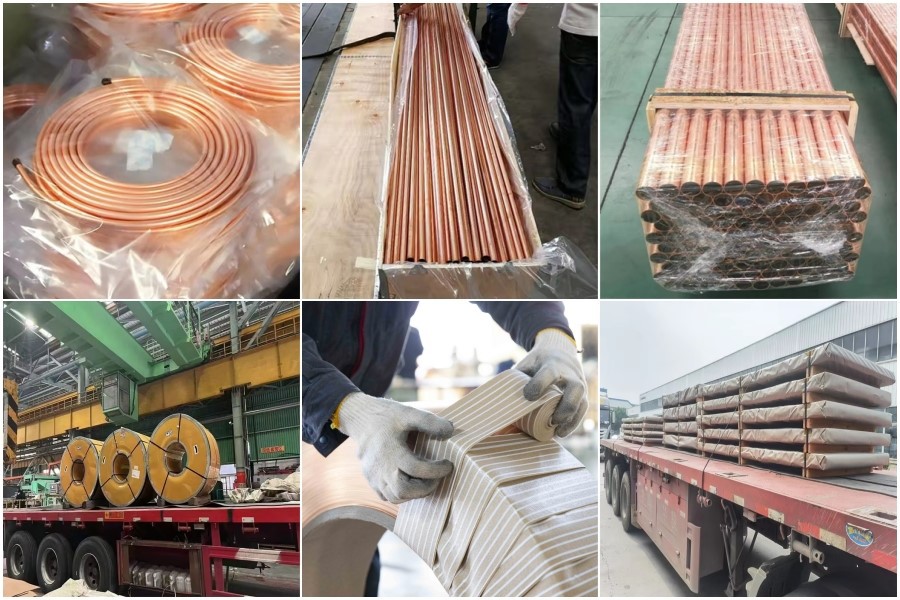
All our copper products - including sheets, plates, bars, tubes, strips, and custom CNC-machined components - are packed to meet international export standards and ensure safe delivery. Products are individually protected with anti-rust paper or VCI film, then securely bundled on sturdy wooden pallets or steel-framed export crates, with reinforced edge protection and moisture-barrier wrapping to prevent surface damage and oxidation during transit. Each bundle is clearly labeled with material grade, temper, dimensions, heat number, and quantity. Full mill test certificates (MTC) accompany every shipment. We support both standard and customized packaging solutions based on your logistics requirements, with flexible options for LCL, FCL, or air freight.
Our Factory
We operate a fully integrated copper processing facility spanning over 25,000 square meters, equipped with precision slitting lines, CNC machining centers, plate sawing machines, edge milling equipment, and surface polishing lines dedicated to processing C11000, C10100, C12200 and other high-conductivity copper alloys. Our production team averages over 18 years of experience in copper fabrication, managing everything from raw material inspection to finished component packaging under a strict ISO 9001:2015 quality management system. Each batch undergoes in-house testing for chemical composition, conductivity, hardness, and dimensional accuracy before release. With an annual processing capacity exceeding 8,000 metric tons and a dedicated quality control team monitoring every production stage, we deliver consistent material performance and on-time shipment to customers across North America, Europe, the Middle East, and Southeast Asia.


