


If you're buying copper for a high-pressure refrigeration or gas project, you've likely seen C12200 on every spec sheet. It's not just a random number; it's the industry's way of avoiding leaks. Most buyers choose it because it handles brazing better than standard "pure" copper. If you've ever had a pipe crack right at the joint after a week of operation, you know exactly why the specific grade matters.
Why does C12200 weld without cracking?
The biggest enemy of a copper weld is oxygen. Standard copper (like C11000) has tiny amounts of oxygen that react during brazing, causing "hydrogen embrittlement." This makes the metal brittle and prone to hairline fractures. C12200 has a tiny bit of phosphorus added to "deoxidize" the metal. This makes it much more stable under a torch. In short: if your project involves a lot of brazing or welding, C12200 is the only way to ensure a leak-proof seal.
Will it handle high-pressure refrigerants?
With new gases like R410A, the internal pressure in a cooling system is higher than ever. A cheap pipe with uneven wall thickness is a liability. C12200 is preferred because it has the right balance of strength and ductility. You can bend it or flare it without the wall thinning out or snapping. If the copper is too hard, it cracks; if it's too soft, it kinks. C12200, when processed correctly, gives you that "just right" flexibility for tight mechanical rooms.
How to spot "fake" C12200 in a shipment?
The most common trick in the market is selling C11000 (which is cheaper) as C12200. On the surface, they look identical. However, the difference shows up during the "flare test." Take a sample and flare the end; if you see tiny cracks or an "orange peel" texture, the phosphorus content is likely off, or the grain size is too large. Another red flag is the weight. Always check your micrometer-if the wall is consistently 0.05mm thinner than ordered, the supplier is "skimming" metal to lower the price.
Why do we put plastic caps on every pipe?
It's a small detail, but it tells you a lot about the supplier. For HVAC and medical gas, internal cleanliness is life or death. If a pipe sits in a warehouse or a shipping container without end caps, moisture and dust get inside. That moisture leads to internal oxidation. When you finally install that pipe, that "soot" can clog expansion valves or ruin a compressor. We snap on tight-seal caps immediately after production to keep the bore factory-clean until the moment you're ready to weld.
How do we guarantee the wall thickness?
We don't just rely on the machine settings. Every batch of our C12200 goes through an Eddy Current Tester (ECT). This isn't just a fancy term-it's a machine that "scans" the pipe for invisible thin spots or pinholes that the naked eye would miss. This is why our pipes don't fail during the final nitrogen pressure test on-site. We manage the process from the raw copper melt to the final annealing to ensure the grain structure is uniform for every meter you buy.
Packaging & Shipping
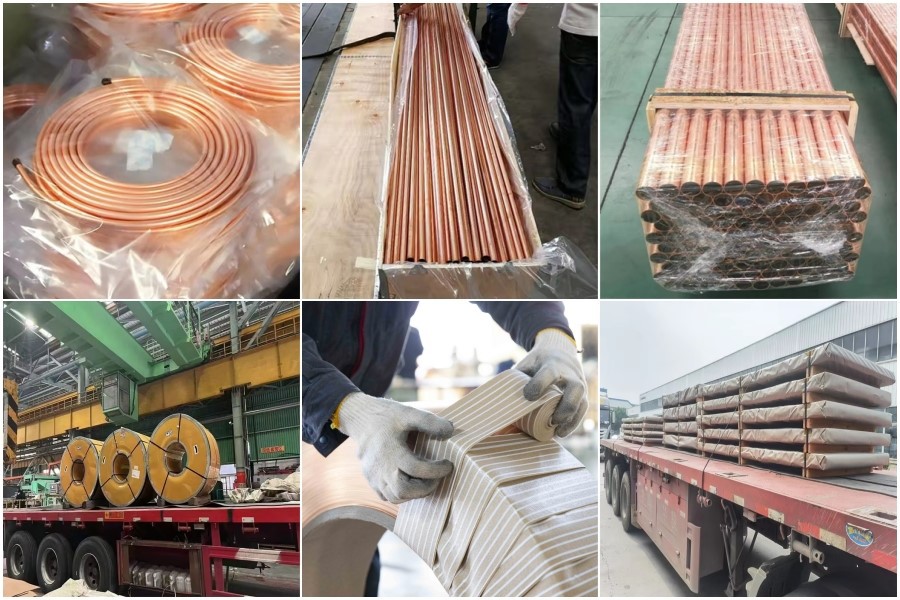
All our copper products - including sheets, plates, bars, tubes, strips, and custom CNC-machined components - are packed to meet international export standards and ensure safe delivery. Products are individually protected with anti-rust paper or VCI film, then securely bundled on sturdy wooden pallets or steel-framed export crates, with reinforced edge protection and moisture-barrier wrapping to prevent surface damage and oxidation during transit. Each bundle is clearly labeled with material grade, temper, dimensions, heat number, and quantity. Full mill test certificates (MTC) accompany every shipment. We support both standard and customized packaging solutions based on your logistics requirements, with flexible options for LCL, FCL, or air freight.
Our Factory
We operate a fully integrated copper processing facility spanning over 25,000 square meters, equipped with precision slitting lines, CNC machining centers, plate sawing machines, edge milling equipment, and surface polishing lines dedicated to processing C11000, C10100, C12200 and other high-conductivity copper alloys. Our production team averages over 18 years of experience in copper fabrication, managing everything from raw material inspection to finished component packaging under a strict ISO 9001:2015 quality management system. Each batch undergoes in-house testing for chemical composition, conductivity, hardness, and dimensional accuracy before release. With an annual processing capacity exceeding 8,000 metric tons and a dedicated quality control team monitoring every production stage, we deliver consistent material performance and on-time shipment to customers across North America, Europe, the Middle East, and Southeast Asia.

Get Fast Quote & Logistics Plan


