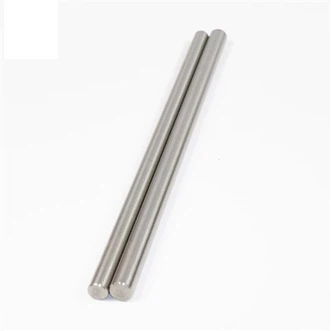
Titanium alloy is a lightweight, corrosion-resistant, and high-strength material, and the resulting application to smartphones can improve the overall strength, drop resistance, and scratch resistance of the phone. However, titanium alloy is a difficult material to process, and the introduction of titanium alloy bezels is a challenge in CNC technology. Why do we think titanium alloy is a difficult-to-machine material? Let's recognize its properties together.
Titanium is an element with atomic number 22 in the periodic table, a subgroup element of the fourth cycle, i.e., group IVB, which is a group of elements other than titanium, zirconium and hafnium, whose common feature is a high melting point and the formation of a stable oxide film on its surface at room temperature.


Ten characteristics of titanium
1, low density, high strength, high specific strength
Titanium's density is 4.51g/cm3, 57% of steel, titanium is less than twice as heavy as aluminum, three times stronger than aluminum. Titanium alloy specific strength (strength / density ratio) is commonly used in industrial alloys in the largest (see Table 1), titanium alloy specific strength is 3.5 times that of stainless steel, aluminum alloy 1.3 times that of magnesium alloys, 1.7 times, so it is the aerospace industry is essential to the structure of the material.
2,Excellent corrosion resistance
The passivity of titanium depends on the presence of an oxide film, which has much better corrosion resistance in oxidizing media than in reducing media. High rate corrosion occurs in reducing media. Titanium does not corrode in some corrosive media, such as seawater, wet chlorine gas, chlorite and hypochlorite solutions, nitric acid, chromic acid, metal chlorides, sulfides, and organic acids. However, in media that react with titanium to produce hydrogen (e.g. hydrochloric and sulfuric acids), titanium usually has a large corrosion rate. However, if a small amount of oxidizing agent is added to the acid, a passivation film will form on the surface of titanium. Therefore, titanium is corrosion-resistant in strong sulfuric acid-nitric acid or hydrochloric acid-nitric acid mixtures, and even in hydrochloric acid containing free chlorine. The protective oxide film of titanium is often formed when the metal encounters water, even in small amounts of water or water vapor. If titanium is exposed to a strongly oxidizing environment in the complete absence of water, rapid oxidation occurs and violent reactions and even spontaneous combustion often occur. Such phenomena have occurred when titanium reacts with fuming nitric acid containing excess nitrogen oxide, and when titanium reacts with dry chlorine gas. Therefore, a certain amount of water is necessary to prevent such reactions.
3,Good heat resistance
Usually aluminum at 150 ℃, stainless steel at 310 ℃ that is the loss of the original performance, and titanium alloy at 500 ℃ or so still maintain good mechanical properties. When the aircraft speed reaches 2.7 times the speed of sound, the surface temperature of the aircraft structure reaches 230 ℃, aluminum alloys and magnesium alloys can not be used, while titanium alloys can meet the requirements. Titanium's heat resistance is good, it is used for aero-engine compressor disk and blade and the skin of the rear fuselage of the aircraft.
4,Good low temperature performance
Certain titanium alloys (such as Ti-5AI-2.5SnELI) strength with the reduction of temperature and increase, but the plasticity is not reduced much, still have good ductility and toughness at low temperatures, suitable for use in ultra-low temperatures. Can be used in dry liquid hydrogen and liquid oxygen rocket engines, or in manned spacecraft for the use of ultra-low temperature containers and storage tanks.
5, non-magnetic
Titanium is non-magnetic, it is used in submarine shells, will not cause the explosion of mines.
6, small thermal conductivity
7, low modulus of elasticity
8, tensile strength and yield strength is very close to the
Ti-6AI-4V titanium alloy tensile strength of 960MPa, yield strength of 892MPa, the difference between the two is only 58MPa.
9, titanium is easy to be oxidized at high temperatures.
Titanium and hydrogen-oxygen bonding force is strong, we should pay attention to prevent oxidation and hydrogen absorption. Titanium welding should be carried out under argon protection to prevent contamination. Titanium tubes and plates should be heat-treated under vacuum, titanium forgings heat treatment to control the micro-oxidizing atmosphere.
10, low damping resistance
Titanium and other metal materials (copper, steel) made of the same shape and size of the clock, with the same force to each clock will find that the clock made of titanium oscillates up to the sound of a long time, i.e., by striking the energy given to the clock is not easy to disappear, so we say that titanium's damping performance is low.
Three special functions of titanium
01Shape memory function
This refers to the ability of Ti-50%Ni (atomic) alloy to recover its original shape under certain temperature conditions, and it is called a shape memory alloy.
02Superconductivity
Refers to the Nb-Ti alloy, when the temperature drops to close to absolute zero, Nb-Ti alloy made of wire, will lose resistance, any large current through the wire will not heat up, no energy consumption, Nb-Ti is known as superconducting materials.
03Hydrogen storage function
This refers to the Ti-50%Fe (atomic) alloy, which has the ability to absorb large amounts of hydrogen. By utilizing this characteristic of Ti-Fe, hydrogen can be stored safely, i.e., it is not necessary to use steel high-pressure cylinders to store hydrogen. Under certain conditions, Ti-Fe can also be used to release hydrogen, and Ti-Fe is called an energy storage material.