


If you are a procurement manager, you've probably seen a dozen different ASTM codes thrown around. For C12200 copper pipes, the most common ones are ASTM B280 and ASTM B75. Choosing the wrong one isn't just a technicality-it can get your entire project rejected by the inspector. Here is the breakdown of what these codes actually mean for your job site.
Is ASTM B280 mandatory for your HVAC project?
If you are working on Air Conditioning and Refrigeration (ACR) systems, the answer is almost always yes. ASTM B280 isn't just about the copper being C12200; it's about cleanliness.
The standard requires the internal surface to be virtually free of any residue. Why? Because even a tiny amount of drawing oil can react with modern refrigerants and clog the expansion valves. When we produce B280-compliant pipes, we go through an extra cleaning and capping stage that a "general-purpose" pipe simply doesn't get. If your spec sheet says ACR, don't try to save money with B75.
What is the difference with ASTM B75?
ASTM B75 is the "seamless copper tube" standard for general engineering. It's perfect for plumbing, gas lines, or heating systems where extreme internal cleanliness isn't as critical as it is for a refrigeration circuit.
The main advantage of B75 is that it covers a much wider range of tempers and sizes. If you need a specific wall thickness for a custom heat exchanger or a water line, B75 is usually the go-to. It's still C12200 (Phosphorus-Deoxidized), but it's tested for different mechanical properties rather than just "cleanliness."
How can you tell if an MTC report is real?
Anyone can send you a PDF that says "C12200 - ASTM B280." But in the real world, a Mill Test Certificate (MTC) is only worth the paper it's printed on if it has traceability.
A genuine MTC should list the "Heat Number"-this is like the copper's DNA. You should be able to match the heat number on your certificate to the stamps on the pipe or the tags on the wooden crate. When we ship a container, we ensure the documentation and the physical goods are perfectly synced. If a supplier is hesitant to provide a sample MTC before you pay, it's a major red flag that they might be mixing different grades of copper.
What tests should you demand before the pipes leave the factory?
Don't just take the factory's word for it. There are three tests that should be non-negotiable for C12200:
Eddy Current Testing (ECT): This scans 100% of the pipe length for hidden wall defects.
Flare/Flattening Test: This ensures the pipe won't crack when your team starts bending it on-site.
Grain Size Analysis: This confirms the annealing was done correctly so the pipe has the right "softness."
We perform these as standard procedure because we know that by the time the pipes reach your warehouse in the US, Europe, or the Middle East, it's too late to fix a manufacturing error.
Does your supplier offer full "Heat Number" traceability?
We've seen cases where a contractor buys copper, installs it, and then the building inspector demands proof of origin months later. If you can't provide it, you're looking at a "rip-and-replace" nightmare.
What we do in our facility is maintain a strict digital log of every batch. From the raw copper cathode to the final bright annealing furnace, we know exactly who handled that pipe and what the chemical lab results were. This transparency is why our C12200 pipes are used in everything from medical oxygen lines to high-rise HVAC systems.
Packaging & Shipping
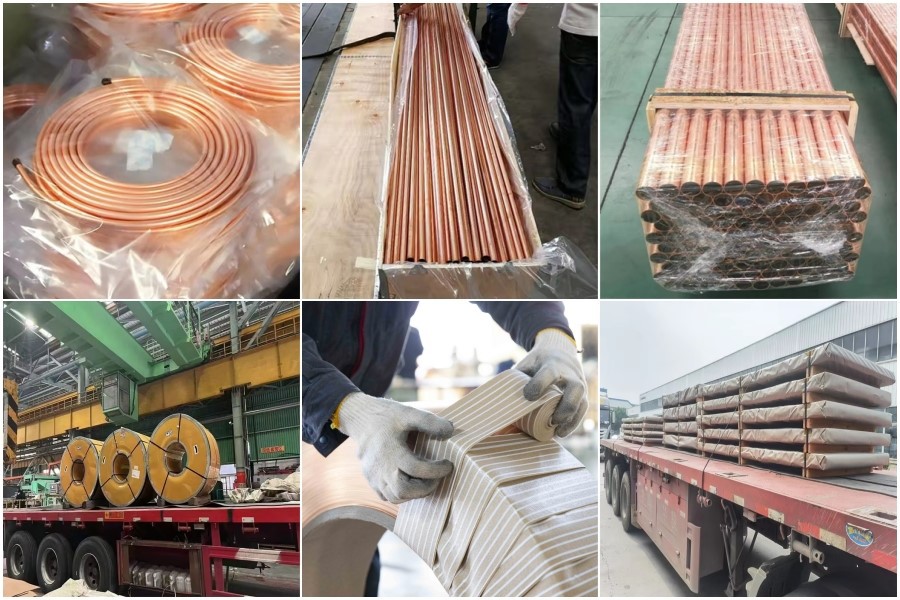
All our copper products - including sheets, plates, bars, tubes, strips, and custom CNC-machined components - are packed to meet international export standards and ensure safe delivery. Products are individually protected with anti-rust paper or VCI film, then securely bundled on sturdy wooden pallets or steel-framed export crates, with reinforced edge protection and moisture-barrier wrapping to prevent surface damage and oxidation during transit. Each bundle is clearly labeled with material grade, temper, dimensions, heat number, and quantity. Full mill test certificates (MTC) accompany every shipment. We support both standard and customized packaging solutions based on your logistics requirements, with flexible options for LCL, FCL, or air freight.
Our Factory
We operate a fully integrated copper processing facility spanning over 25,000 square meters, equipped with precision slitting lines, CNC machining centers, plate sawing machines, edge milling equipment, and surface polishing lines dedicated to processing C11000, C10100, C12200 and other high-conductivity copper alloys. Our production team averages over 18 years of experience in copper fabrication, managing everything from raw material inspection to finished component packaging under a strict ISO 9001:2015 quality management system. Each batch undergoes in-house testing for chemical composition, conductivity, hardness, and dimensional accuracy before release. With an annual processing capacity exceeding 8,000 metric tons and a dedicated quality control team monitoring every production stage, we deliver consistent material performance and on-time shipment to customers across North America, Europe, the Middle East, and Southeast Asia.


