


When you're installing a piping system behind a wall or under a concrete floor, you aren't thinking about next year-you're thinking about the next few decades. Most contractors assume all copper is the same, but the reality is that the wrong grade can lead to "pinhole leaks" in less than five years. For C12200 (DHP copper), the long-term reliability isn't just a marketing claim; it's a result of how the metal is deoxidized.
Why do some copper pipes leak within 5 years?
The most common killer of copper tubing is "pitting corrosion." This happens when small impurities in the metal or oxygen bubbles in the water attack the pipe wall. Standard pure copper (C11000) is great for electricity, but in plumbing or HVAC, those tiny oxygen pockets are a liability. Because C12200 has phosphorus added to remove oxygen, it creates a much more stable internal surface. This stable layer prevents the chemical "pitting" that turns a solid pipe into a sieve.
Can C12200 handle "hard water" or soil?
If your project is in an area with aggressive water or if the pipes are buried, the corrosion risk triples. C12200 is the industry standard for underground gas and water lines because it handles soil chemistry better than other alloys. The phosphorus-deoxidized structure allows the pipe to form a protective "patina" (that greenish-brown layer) quickly and evenly. Once this layer forms, it acts as a shield, stopping further corrosion. If you use a lower-grade pipe, that patina might be uneven, leaving "weak spots" that eventually burst under pressure.
Does the "finish" of the pipe matter?
A lot of people ask us: "Why does the inside of your pipe look so bright?" It's not just for aesthetics. If a factory leaves residual drawing oil inside the tube and then heats it (anneals it), that oil turns into a carbon film. This film is a magnet for corrosion. In our facility, we use a multi-stage degreasing process before the pipe even enters the furnace. If the inside isn't "bright and clean," you're essentially installing a pipe that has already started the corrosion process.
Why do we use nitrogen during annealing?
To get the copper to the right "softness" (temper) for bending, it has to be heated. If you heat copper in regular air, it oxidizes instantly-that's the black scale you see on cheap pipes. We perform "Bright Annealing" in a 100% nitrogen atmosphere. This keeps the pipe perfectly clean, inside and out. It's an extra step that costs us more in production, but it means your technicians don't have to spend hours flushing the system to protect the expansion valves and compressors.
How do we pack pipes for long-term storage?
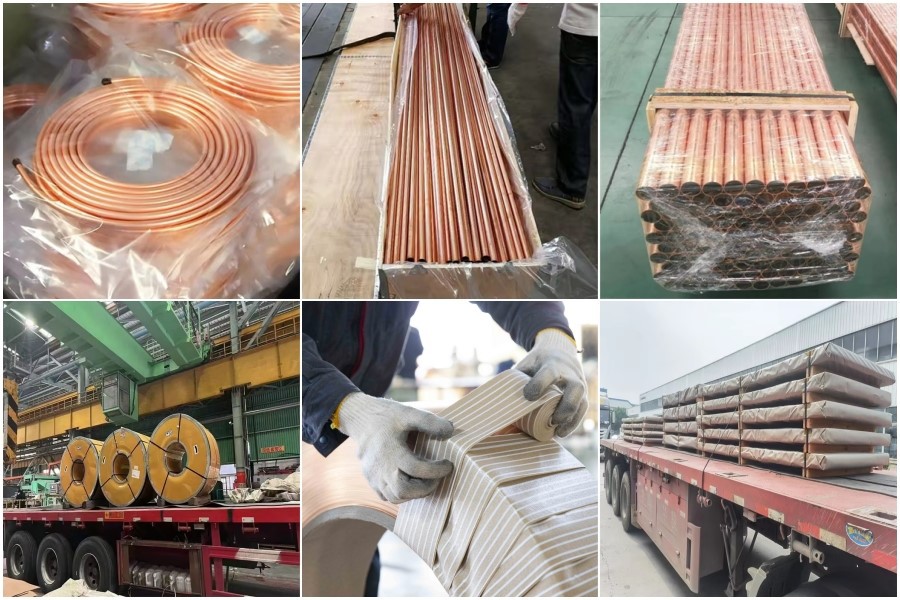
Copper is a commodity, and sometimes it sits in a warehouse for months before it's used. If it's just bundled with a string, the humidity will start dulling the surface on day one. We use thick-walled plastic end caps and heavy-duty shrink-wrap for every bundle. This isn't just to keep it pretty; it's to ensure that when you finally pull that pipe out of the crate six months from now, it's still in "medical-grade" condition-no oxidation, no dust, and no moisture.
Packaging & Shipping
All our copper products - including sheets, plates, bars, tubes, strips, and custom CNC-machined components - are packed to meet international export standards and ensure safe delivery. Products are individually protected with anti-rust paper or VCI film, then securely bundled on sturdy wooden pallets or steel-framed export crates, with reinforced edge protection and moisture-barrier wrapping to prevent surface damage and oxidation during transit. Each bundle is clearly labeled with material grade, temper, dimensions, heat number, and quantity. Full mill test certificates (MTC) accompany every shipment. We support both standard and customized packaging solutions based on your logistics requirements, with flexible options for LCL, FCL, or air freight.
Our Factory
We operate a fully integrated copper processing facility spanning over 25,000 square meters, equipped with precision slitting lines, CNC machining centers, plate sawing machines, edge milling equipment, and surface polishing lines dedicated to processing C11000, C10100, C12200 and other high-conductivity copper alloys. Our production team averages over 18 years of experience in copper fabrication, managing everything from raw material inspection to finished component packaging under a strict ISO 9001:2015 quality management system. Each batch undergoes in-house testing for chemical composition, conductivity, hardness, and dimensional accuracy before release. With an annual processing capacity exceeding 8,000 metric tons and a dedicated quality control team monitoring every production stage, we deliver consistent material performance and on-time shipment to customers across North America, Europe, the Middle East, and Southeast Asia.

Check Today's Stock & Lead Time


