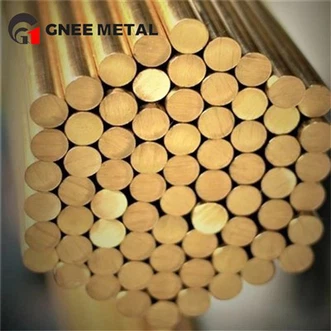
Brass rods have good processing properties and can be formed through a variety of processes such as casting, forging, and extrusion. At the same time, it has excellent electrical conductivity and is an important material in the electrical industry. In addition, brass rods also have excellent corrosion resistance and can maintain stable performance in various environments.
The history of brass rods can be traced back to ancient times, but it was not until the development of modern industry that it began to be widely used. In China, the use of brass can be traced back to the Jiajing period of the Ming Dynasty, when brass began to be used for casting coins. Today, brass rods have become an indispensable material in industrial production.
The manufacturing process of brass rods requires multiple stages. First, the copper and zinc in the raw materials need to be smelted to form brass liquid. In this process, impurities in the furnace will be separated to ensure the quality of the brass rod. Next, the brass liquid needs to go through the impurity removal stage to remove impurities such as iron and phosphorus. Impurity removal is generally achieved by adding appropriate flux, and vacuum impurity removal, filtration and other methods can also be used. After the impurity removal is completed, the brass liquid is poured into the mold to form a brass rod of the desired shape. In this process, parameters such as temperature and pouring speed need to be controlled to ensure that the size and performance of the product meet the requirements.
After the brass rod is formed, it needs to be surface polished to remove surface defects and improve the surface quality of the product. Appropriate abrasives and process parameters should be used during the polishing process to ensure that the surface roughness meets the requirements, while avoiding excessive polishing and material loss. Finally, the brass rod needs to undergo strict quality inspection, including size, shape, surface quality and other aspects. Only brass rods that meet the quality requirements can enter the packaging link and finally be delivered to customers.
The application range of brass rods is very wide. In the field of construction, brass rods are used to make doors, windows, pipes and other parts. Its excellent corrosion resistance enables it to maintain stable performance under various climatic conditions. In the field of machinery, brass rods are used to manufacture various precision instruments, ship parts, gun shells, etc. Its good processing performance and wear resistance enable it to meet complex working environments. In the electrical field, brass rods are widely used in the manufacture of wires, cables, electrical appliances and other products due to their excellent conductivity. In addition, brass rods are also used in the manufacture of chemical equipment, musical instruments, decorations and other fields.
There are many types of brass rods, made of different materials.